In a town whose life depends on the sea, the arrival of a ship brings opportunities for trade, but also questions of safety. Before the crew could meet the townspeople, before cargo could be unloaded and goods exchanged, it was necessary to establish where the ship had come from, what documents it carried and whether there was a risk of infection. The health regulations for Senj and Karlobag show how, in the mid-eighteenth century, the authorities sought to regulate this sensitive encounter between sea and shore.
Alongside the Statute of Karlobag of 1757 , this document opens another chapter in the town’s history: the protection of the community in maritime traffic. The ordinance is dated 15 December 1757, while the surviving booklet was printed in Trieste in 1759 during the reign of Maria Theresa. Its title expressly includes Senj and Karlobag and states that it is an extract from the general regulations for the whole of the Austrian Littoral.
Health Regulations for Senj and Karlobag
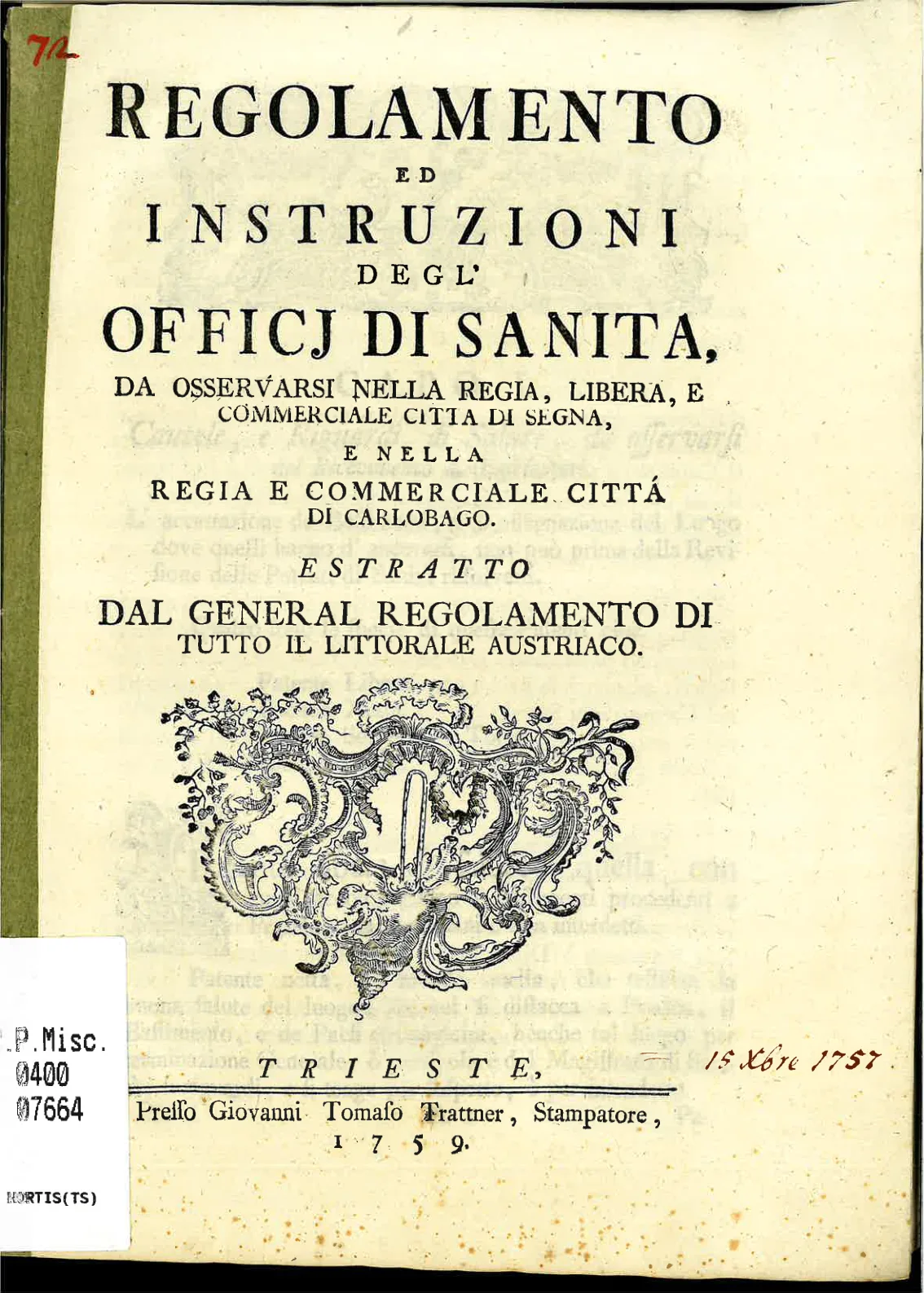
Regolamento ed instruzionidegl’officj di sanitàSegna e Carlobago · Trieste, 1759.
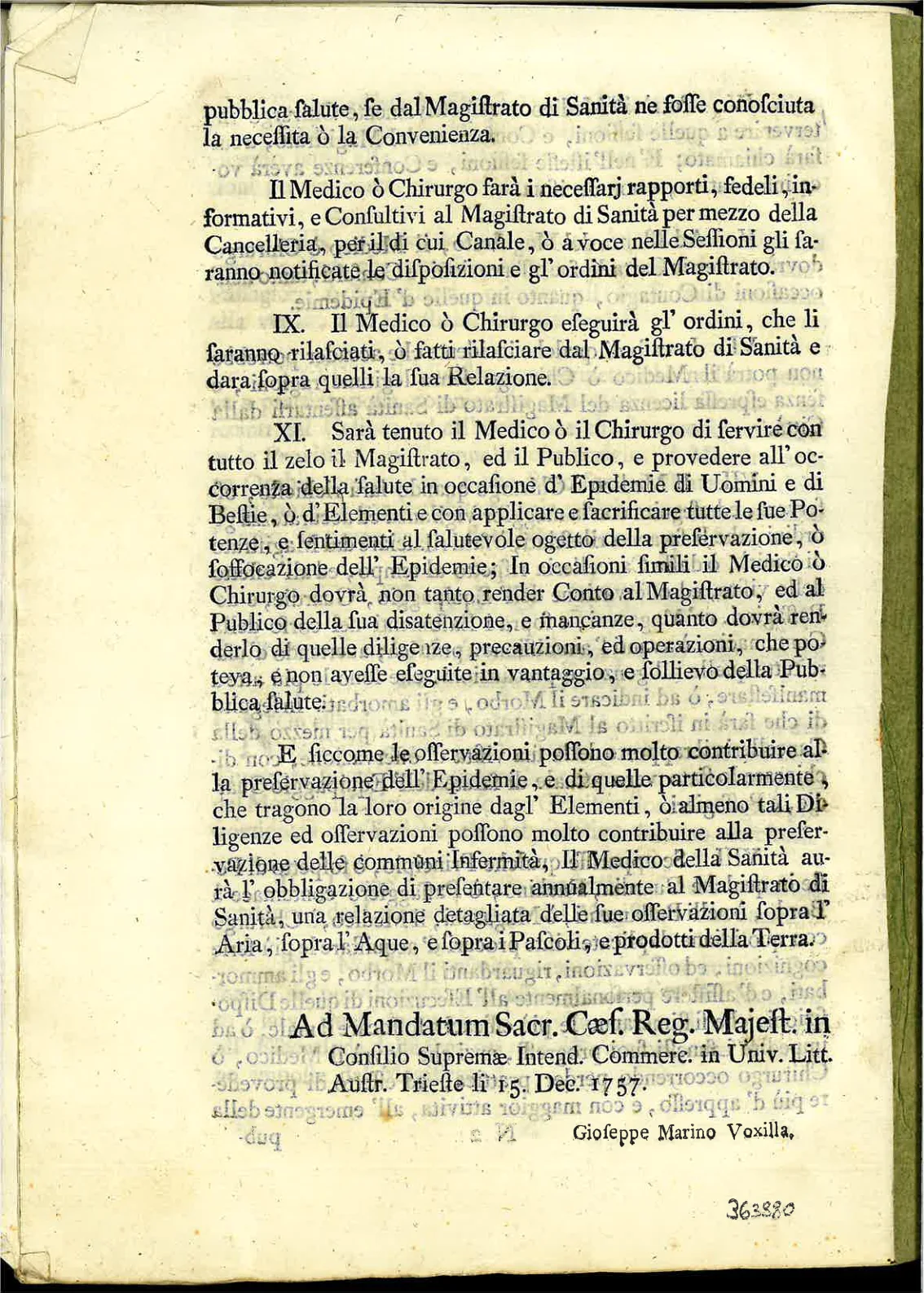
The surviving copy of the regulations for the health offices of Senj and Karlobag is held by the “A. Hortis” Civic Library in Trieste. Its title page, the provision concerning lazarets and its closing date connect the printed edition with the town’s history. You can explore the complete original in the gallery of digitised pages below.
Title page of the 1759 printed edition
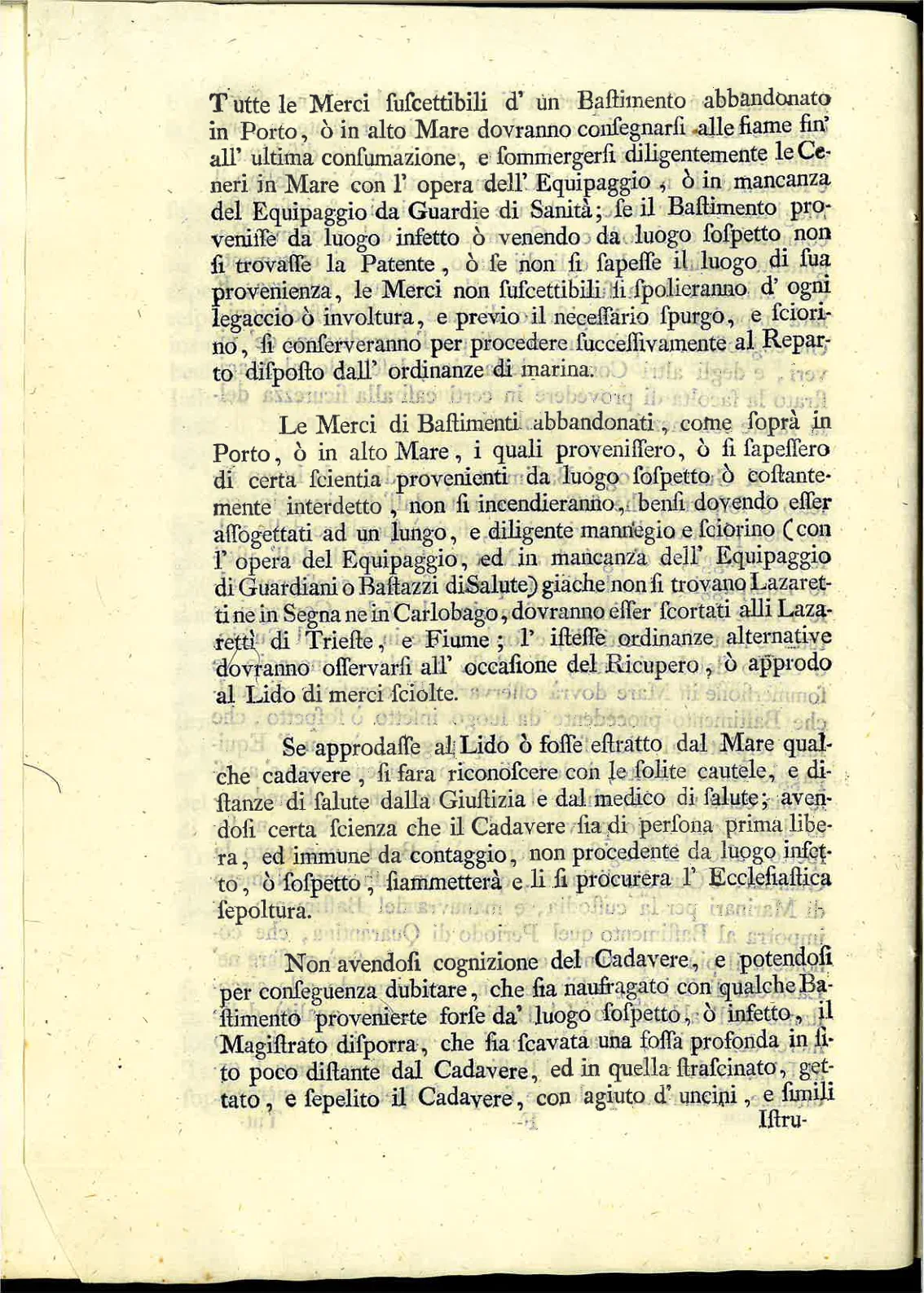
Senj and Karlobag in the provision concerning lazarets
From civic order to the protection of public health
The statute and health regulations: two complementary views of the town
The Statute of Karlobag regulates civic life, while the health regulations define more closely the procedures for protecting health in maritime traffic. Both documents belong to the same period, but serve different purposes. The health regulations govern the work of health offices, the duties of their officials and measures to prevent infection.
Their connection with the statute can therefore be understood through the daily life of the harbour. A ship’s arrival was more than a maritime event. For the health authorities, it required the examination of documents, checks on the crew and cargo, and a decision on whether contact with the shore could be permitted. Health protection directly determined when trade could begin.
From general regulations to local health offices
The regulations for Senj and Karlobag formed part of a wider reorganisation of maritime health administration during Maria Theresa’s reign. In his historical study published in 1888, N. Ebner von Ebenthall records that general health regulations for the Austrian Littoral were issued in 1755. They covered the admission of ships, unloading, the handling of goods, quarantine and the duties of health officials.
The author describes the law of 15 December 1757 as an organisational supplement to that system and a set of instructions for the authorities responsible for implementing it. The surviving booklet for Senj and Karlobag thus belongs to the development of shared rules intended to reconcile maritime traffic with protection against infection.
Source: N. Ebner von Ebenthall, Maria Theresia und die Handelsmarine, Trieste, 1888, pp. 89–90.
Who was responsible for safeguarding health?
The regulations govern the work of the health magistracy, the administrative body responsible for health matters. Its work involved a range of officials: a chancellor, supervisors, harbour officials, guards, and a physician or surgeon. Their duties concerned declarations, inspections, supervision, record-keeping and reporting.
Karlobag formed part of a wider administrative network. Chapter VIII defines the relationship between its health authorities and those of Senj and Trieste. The magistracy at Karlobag corresponded with that at Senj, and the magistracy at Senj with that at Trieste. Important information on health conditions had to be communicated promptly and faithfully, while the decisions of the competent authorities had to be available and considered at meetings.
Ebner von Ebenthall expressly states that health commissions administered the maritime health service in Rijeka, Senj and Karlobag, while the health magistracy in Trieste directed health affairs throughout the Austrian Littoral. His account confirms Karlobag’s place within this network, alongside the channels of correspondence specified in the regulations presented here.
Source: N. Ebner von Ebenthall, Maria Theresia und die Handelsmarine, Trieste, 1888, pp. 17 and 93–94.
Before unloading: the bill of health, crew and cargo
The first chapter opens with the rule that no decision may be taken on a ship’s admission or its anchorage before its health documents, known as patenti di sanità, have been examined. The text distinguishes several types of these documents. On their basis, the health authorities assessed the risk of infection associated with a ship’s place of origin. A favourable bill of health therefore did not always mean unconditional admission.
The regulations describe a health officer or guard going out in a boat to meet certain ships. They had to establish where the ships had come from, what bill of health they carried and what they were transporting. The regulations then require the master’s declaration, examination of the bill of health, verification of the crew and declaration of the cargo. The granting of free pratique, libera pratica, opened the way to unloading and contact with others.
Health inspection was thus a prescribed condition for maritime traffic and trade. The regulations distinguish between Senj and Karlobag: ships carrying a patente netta, which certified favourable health conditions at their place of departure, but arriving from places covered by a general health prohibition, could be admitted at Senj, but not at Karlobag.
Quarantine and the handling of goods
When free pratique was withheld, procedures for separation and supervision followed. The text uses the terms contumacia and quarantina, referring to a period spent under health restrictions. The provisions cover ships, passengers, crews, goods and those who supervise them. The duration of detention and the conditions for release depended on the circumstances specified in the regulations.
The regulations pay particular attention to goods and packaging that the authorities of the time regarded as possible carriers of infection. They describe the removal of wrappings and ties, the exposure of certain objects to water, airing and other procedures. In some cases, they also prescribe burning. Such provisions reveal contemporary understandings of danger and approaches to managing risk.
Even the end of detention did not mean an automatic return to unrestricted activity. Chapter VI requires guards’ reports, an examination by a physician or surgeon, and verification of the cargo. Passengers, ships and goods could not be granted free pratique without an order from the health chancery.
Karlobag in the original document
„… non si trovano Lazaretti né in Segna né in Carlobago …”
“…there are no lazarets either at Senj or at Karlobag…”
In the provision concerning goods from abandoned ships, the regulations expressly state that neither Senj nor Karlobag has a lazaret. Certain goods from ships arriving from suspected places or places under a permanent health prohibition were to be sent to the lazarets at Trieste or Rijeka. The passage refers to the situation described in these regulations in the mid-eighteenth century.
Original document, provisions concerning abandoned ships and goods.
The physician, the patient and responsibility towards the community
Behind the administrative procedures were people. If a master, passenger, sailor, guard or porter fell ill during detention, the regulations required assistance from a physician or surgeon. A written report on the course of the illness, symptoms, treatment and medicines administered had to be submitted to the health authorities every day.
The closing provisions look beyond the arrival of a ship. The physician or surgeon was obliged to serve public health in the event of epidemics, and the health physician had to report annually on his observations of the air, waters, pastures and produce of the land. The document thus links the supervision of maritime traffic with environmental observation and responsibility for the population’s health.
Severe penalties for false health documents
A later patent, dated 25 August 1766, illustrates the importance the authorities attached to authentic health documents. According to the patent reproduced in Macher’s 1846 collection, forging health documents and misusing them were punishable by death by hanging i. The same penalty applied to officials who admitted a person while knowing that the document was forged. This was a later enactment, rather than a provision of the 1757 regulations for Senj and Karlobag.
Source: Mathias Macher, Handbuch der k. k. Sanität-Gesetze und Verordnungen, vol. I, 1846, pp. 85–90, especially p. 86, clause 1.
The importance attached to these penalties is also evident in the later sanitary ordinance. It required the patent of 25 August 1766 and the relevant statutory article to be read out in the language of the country at every change of the cordon guard i. The rule thus sought to keep those entrusted with border supervision informed of their obligations and the consequences of violating them.
Source: Sanitary ordinance of Maria Theresa, digitised copy ORSZ_ORVO_Muzealis_18, page 10, § VI.
Health precautions and the resumption of trade in 1784
The relationship between trade and protection against infection is illustrated by the limited resumption of maritime trade in 1784 i. A report dated Karlovac, 28 August 1784, describes measures agreed with the sanitary magistracy at Trieste after favourable health reports from Bosnia and Dalmatia. Ships from certain healthy Dalmatian towns and islands could once again be admitted to Senj and Karlobag, provided they carried credible health documents and goods considered incapable of transmitting infection. Ships from Split and its district, St Martin and Brač remained excluded.
The report expressly states that neither Senj nor Karlobag possessed properly established lazarets, so no one was to be admitted there to undergo quarantine. Ships were to be supervised by guards from outside and sanitary precautions observed during unloading. Local sanitary servants were not to be exposed through contact aboard foreign vessels, since there was no facility where they could subsequently complete the prescribed cleansing period. This record shows how the protection of health shaped the possibilities and limits of trade in Karlobag harbour.
Source: digitised collection KlasszikusOrvosiKonyvek_303, pp. 117–119, especially p. 118; report of 28 August 1784.
Karlobag within the eighteenth-century health system
The health regulations reveal the connection between maritime traffic, trade and health protection in Karlobag. Examining ships’ documents, supervising crews and handling goods were among the prescribed measures for protecting the town from infection. Correspondence with Senj and the dispatch of certain goods to the lazarets at Trieste or Rijeka place Karlobag within the wider health system of the Austrian Littoral.
Karlobag’s place in this system is also explicitly recorded in the introduction to the later general sanitary ordinance. Among the earlier maritime regulations, it names the enactment of 15 December 1757, governing the magistracy at Trieste and the sanitary commissions at Rijeka, Senj and Karlobag i. It then confirms all the listed statutory provisions in every part. The regulations presented here therefore also appear in the broader legislative framework for protecting health in the Monarchy.
Source: General sanitary ordinance of Maria Theresa, digitised copy ORSZ_ORVO_Muzealis_17, page 2.
Alongside the Statute of Karlobag of 1757, this document offers an insight into the organisation of the town and its harbour in the mid-eighteenth century. While the statute governs civic life, the health regulations show how the authorities sought to reconcile maritime trade with the protection of the population’s health.
The bill of health of the vessel “Danica” — Karlobag, 1879
More than a century after the health regulations were printed, maritime health inspection left another surviving trace in Karlobag. A bill of health, Fede di sanità, issued on 14 August 1879, records the departure of the bracera “Danica” from the harbour of Karlobag. The Royal Harbour Office certifies that the vessel departs in libera pratica — with free pratique — and that the state of health of the locality and its surroundings is satisfactory.
The certificate records the vessel’s name, a tonnage of ten tons and a crew of two, including the master. The vessel departs without cargo. The reverse contains additional notes concerning a change of ownership, navigation documents and obligations towards a sailor, authenticated by the signature and seal of the harbour office.
The regulations of 1757/1759 and the certificate of 1879 belong to different periods. The first source describes prescribed procedures; the second records a specific act of maritime health administration in Karlobag. Together, they illuminate the role of ships’ documents, official supervision and health safeguards in the life of the harbour.
Source: Archives of the Municipality of Karlobag.
ORIGINAL • TRIESTE, 1759 • BIBLIOTECA CIVICA “A. HORTIS”