
Before the Kurjakovići — the Gusići and Krbava
The Kurjakovići did not emerge as an entirely new family. They descended from the old Croatian Gusić kindred, whose earliest estates lay in the counties of Luka and Sidraga in northern Dalmatia. During the thirteenth century, one branch established itself in Krbava. The prevailing view among historians is that Slovinja became Count of Krbava before 1222, after receiving estates in Krbava County from the king of Hungary and Croatia.
In the second half of the thirteenth century, Matija and Bartol, the sons of Slovinja’s brother Grubiša, held the title of Count of Krbava. Krbava was thus an important Gusić stronghold before the appearance of the Kurjakovići. A direct family relationship between Kurjak and Slovinja or his successors has not been established.
1. Count Kurjak — founder of the Kurjaković family
Count Kurjak first appears in the surviving sources in 1298, recorded as Count of Krbava. His descendants would take the name Kurjaković from him. His emergence coincided with major changes in the Croatian lands, as powerful noble families sought to consolidate control over counties, fortresses, routes and revenues.
Kurjak was connected with the powerful Šubići of Bribir, and in the early fourteenth century his sons Budislav, Pavao and Grgur held offices within their political sphere. Before long, however, the Kurjakovići began to develop political and territorial power of their own.
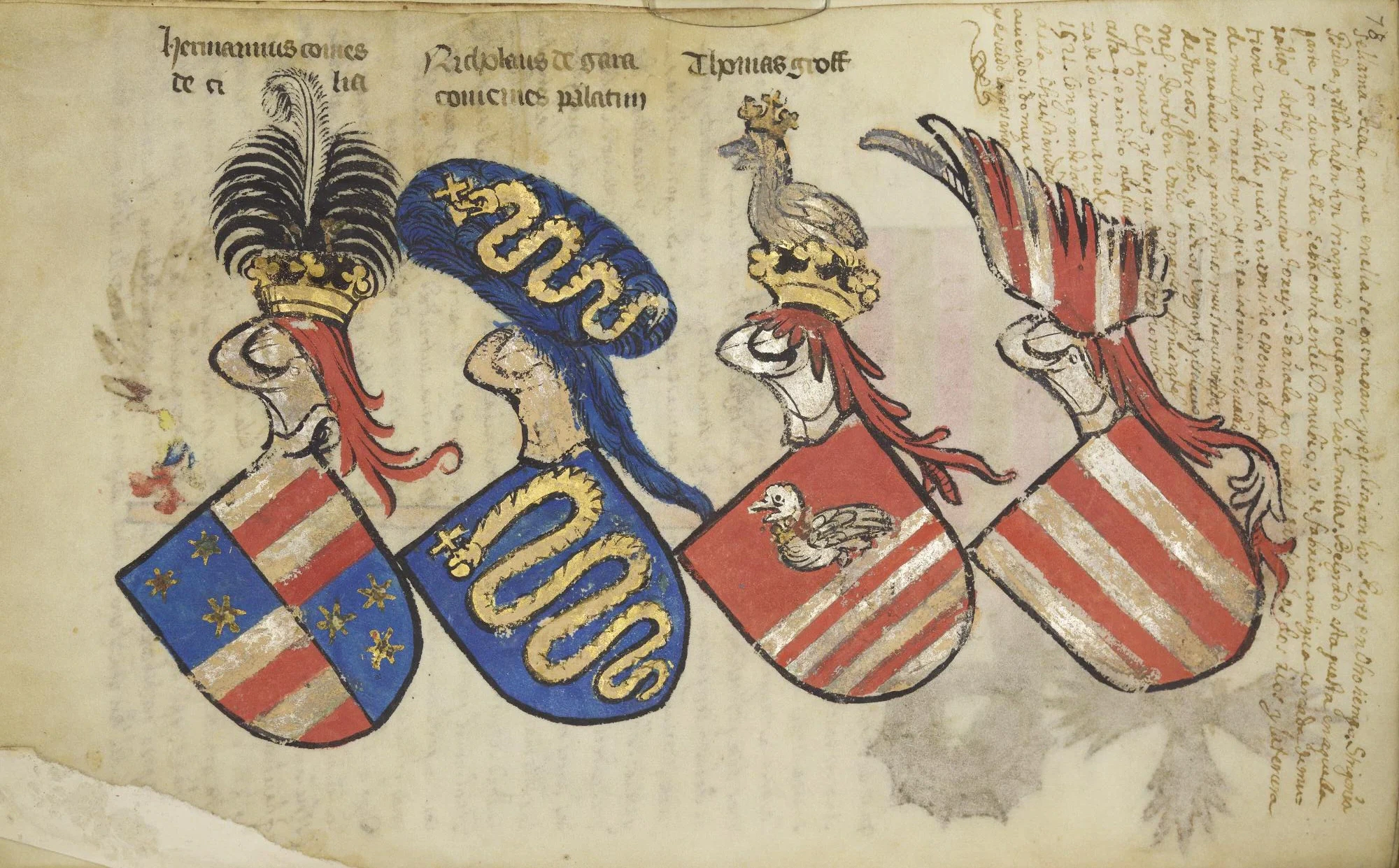
COAT OF ARMS OF THE KURJAKOVIĆ COUNTS OF KRBAVA
Depicted in the armorial Livro de Arautos, 1416.
The third coat of arms from the left belongs to Toma Kurjaković, Count of Krbava.
Source: The University of Manchester Library, John Rylands Library, Latin MS 28, fol. 42v.
2. Budislav, Pavao and Grgur — from heirs to magnates
Kurjak’s three sons — Budislav, Pavao and Grgur — formed the first major generation of the Kurjakovići. In the early decades of the fourteenth century, they operated amid conflicts involving the Šubići, the Nelipčići, the kings of Hungary and Croatia, and other magnates. During the siege of Knin in 1324, the Kurjakovići supported Count Nelipac of the Nelipčić family.
The family divided into several branches during the fourteenth century. Grgur’s branch developed strong connections with Hungary; less information survives about Pavao’s branch. Budislav’s branch remained closely associated with the lordship of Krbava and produced some of the most prominent late medieval members of the family.
3. Expanding their power — Krbava, Lika, Bužani and the routes to the sea
The Kurjakovići’s power did not rest on a single town. During the fourteenth and fifteenth centuries, the counties of Krbava, Lika, Bužani, Hum and Nebljuh, together with territories towards the Zrmanja River and northern Dalmatia, were under their rule or associated with their family. Through marriage alliances and political activity, they also acquired important strongholds such as Zvonigrad and Obrovac.
This distribution of estates had considerable strategic value. The Kurjakovići linked the interior of present-day Lika and Krbava with the Zrmanja region and the Adriatic. Within this network, Bag was more than a peripheral possession: it was a coastal endpoint of the natural and overland routes crossing Velebit between the coast and its hinterland.
The Kurjakovići established their authority over Bag in the early 1320s, as the power of the Šubići of Bribir declined. Following the fall of Ban Mladin II in 1322, Kurjak’s sons took possession of Bag and shared it with their kinsman, Count Petar Disislavić. The town became one of their coastal strongholds, while later charters document the relationship between the counts and the town community.
4. Why was Bag important?
Medieval Bag stood where the sea, Velebit and the routes towards Lika met. For a noble family whose principal estates lay inland, control of such a place provided access to maritime connections and an opportunity to control movement between the coast and the hinterland.
Bag’s charters also provide evidence of its economic life. The charter of 1387 confirms rights to grazing, mowing, cultivating land and cutting timber in the mountain hinterland. The charter of 1432 regulates dues, services and the town’s administration of justice, and mentions vineyards, woods, fields and livestock. Together, these provisions reveal a community whose life was connected both to the coast and to the Velebit hinterland.
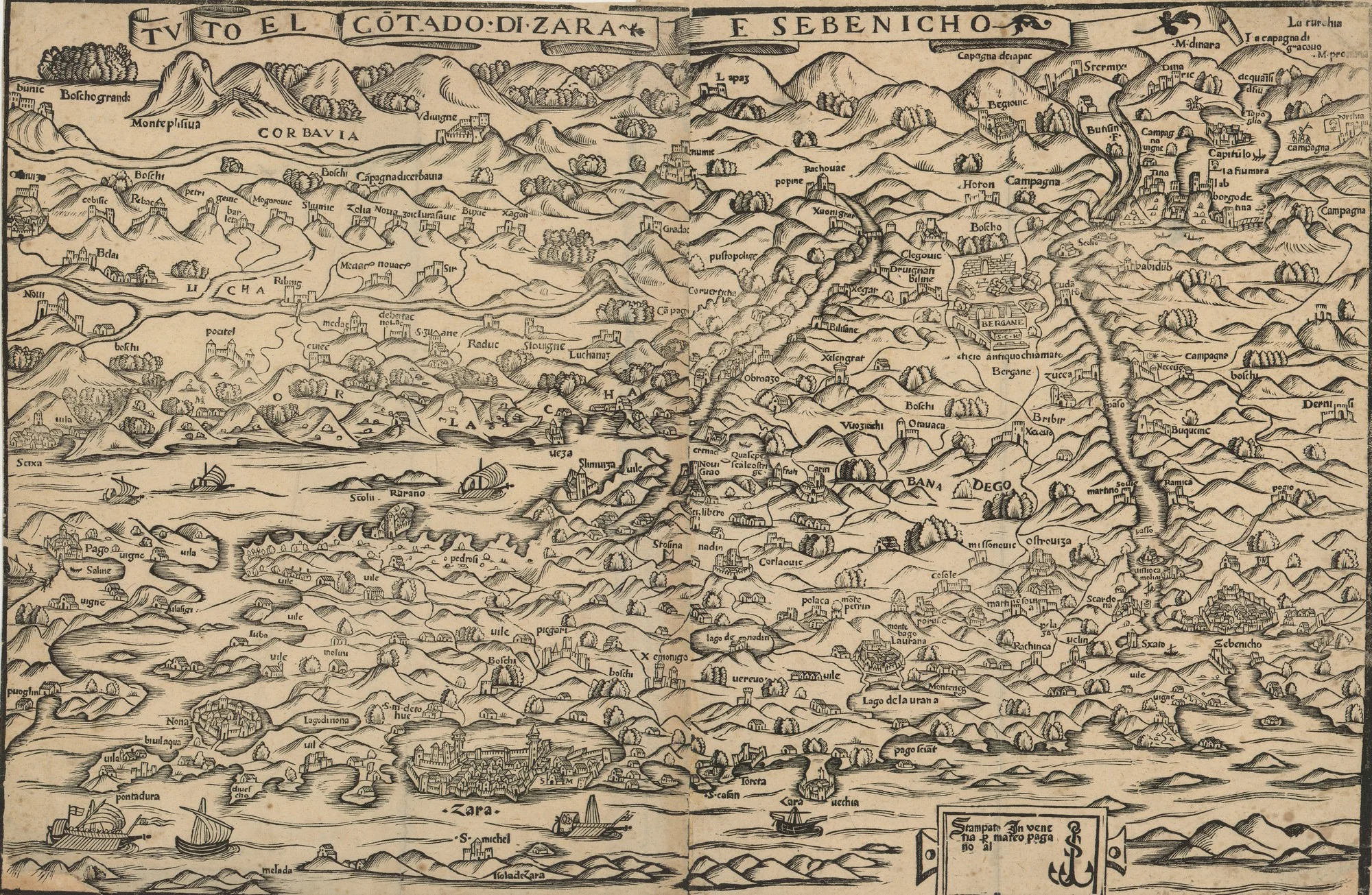
MAP OF THE ZADAR AND ŠIBENIK REGIONS
Around 1530.
Karlobag, labelled Scrixa, appears on the left-hand side of the map.
Source: National and University Library in Zagreb, Novak Collection, ZN-Z-XVI-PAG-1530. Matteo Pagano, printer/publisher.
5. Two branches of the Kurjakovići — the charter of 1379 and the connection with Bag
Budislav’s branch is particularly important for understanding the Kurjakovići’s connection with Bag. Budislav was one of Count Kurjak’s sons, and by the late fourteenth century his descendants were acting as lords of a territory linking Krbava and Lika with the Adriatic coast.
Another branch of the family is documented by a charter issued by King Louis I in Buda on 5 July 1379. According to the archival summary, its recipient was Budislav, son of Grgur and grandson of Count Kurjak. In return for faithful service, the king granted him Upper and Lower Zákány and their associated estates in the Hungarian county of Somogy, in exchange for the Slavonian fortresses of Gereben and Zarak. This Budislav belonged to Grgur’s branch and must not be confused with Budislav, Kurjak’s son, whose descendants were connected with Bag. The charter of 1379 is presented here as evidence of the Kurjakovići’s royal connections and property arrangements, rather than as evidence of their authority over Bag.
CHARTER OF LOUIS I — 5 JULY 1379
Grant of estates to Budislav, son of Grgur and grandson of Kurjak.
Preserved as a transcribed text in a charter of King Sigismund dated 19 March 1406.
Source: National Archives of Hungary, National Archives, Budapest — Hungaricana. Diplomatikai Levéltár, DL 100354; Batthyány family, Acta antiqua (Q 383). Former reference: Q 383 / ZÁKÁNY 3 5 25. Description based on the archival summary.
6. The year 1387 — Budislav’s sons and Bag
One of the most important events in the history of medieval Bag took place on 2 November 1387. Representatives of the community of Scrisia, or Bag, appeared before the Counts of Krbava in Obrovac and requested confirmation of their longstanding liberties, rights and privileges.
The charter opens with the words „Nos Nicolaus, Thomas et Butcho, filii olim Comitis Budislai…” — “We, Nikola, Toma and Butko, sons of the late Count Budislav…”. The Latin quotation follows Kukuljević’s printed transcription. Alongside the three brothers, Pavao, son of Karlo, and Karlo, son of Grgur, also issued the charter. The document directly connects Budislav’s branch of the Kurjakovići with Bag. It also reveals an organised town community that approached its lords by invoking rights already acquired.
The text also confirms the boundaries of the town’s territory. The charter of 1387 is therefore a fundamental source for the study of medieval Bag: its community, its territory and its relationship with the Counts of Krbava.
CHARTER OF THE KURJAKOVIĆI TO BAG — 2 NOVEMBER 1387
Text incorporated in Matthias Corvinus’s charter of 1481 and preserved in a manuscript copy made in 1764.
Open four images and the English translation.
Image source: Archives of the Croatian Academy of Sciences and Arts (HAZU), Zagreb, D-VIIa-124 (former reference: U 432 / 7a 124). The printed Latin transcription was published by Ivan Kukuljević Sakcinski in Jura Regni Croatiae, Dalmatiae et Slavoniae, vol. I, Zagreb, 1862, pp. 156–157. The English translation follows that transcription, with reference to the manuscript copy of 1764.
The Kurjakovići in the charters of 1387, 1432 and 1451
The charter of 1387 was issued by three sons of the late Budislav I and two of his grandsons. The family tree shows their relationships, the issuers of the charters of 1432 and 1451, and the documented descendants of the branches displayed. Red marks the issuers of the 1387 charter, blue those of the 1432 charter, and green those of the 1451 charter.
Scroll horizontally to explore the tree. Select “Children” to reveal a person’s descendants.
her name and relationship are not securely established
her origins are not established here
recorded in 1388–1418
Source: Croatian Biographical Lexicon, “Kurjaković”.
Source: Croatian Biographical Lexicon, “Kurjaković”.
widow of Baboneg Babonić of Blagaj; recorded in 1431.
wife of Marko Kladuški; recorded in 1431.
widow of Vukmir Zlatonosović
Wife: Elizabeta Zrinska; recorded as a widow in 1401 and 1402 (Croatian Biographical Lexicon).
printed transcription: Butcho; earlier manuscript reading: Vučko
recorded in Komić in 1402 in connection with a sale of land to Gabrijel Nozdronja
issuer of the 1432 charter
wife of Kokoš of Kaza; her personal name is not given
married into the Zrinski family; her personal name is not given
1312.
No descendants have been identified in the sources consulted.
No descendants have been identified in the sources consulted.
issuer of the 1387 charter
issuer of the 1432 charter
Wife: Margareta Nelipčić; papal permission for their marriage, 1414 (Croatian Biographical Lexicon).
Source: Croatian Biographical Lexicon, “Kurjaković”.
Source: Croatian Biographical Lexicon, “Kurjaković”.
Wife: Doroteja Frankapan (Croatian Biographical Lexicon).
Source: Croatian Biographical Lexicon, “Kurjaković”.
Source: Croatian Biographical Lexicon, “Kurjaković”.
Source: Croatian Biographical Lexicon, “Kurjaković”.
Source: Croatian Biographical Lexicon, “Kurjaković”.
Source: Croatian Biographical Lexicon, “Kurjaković”.
issuer of the 1432 charter
Source: Croatian Biographical Lexicon, “Kurjaković”.
Wife: Katarina Iločka; recorded as a widow in 1493 and 1495. The Croatian Biographical Lexicon explicitly states that they had no descendants.
Source: Croatian Biographical Lexicon, “Kurjaković”.
Source: Croatian Biographical Lexicon, “Kurjaković”.
issuer of the 1387 charter
Wife Katarina, daughter of Ban Vuk Vukčić, recorded in 1401; marriage to Margarita authorised in 1404 (Croatian Biographical Lexicon). Margarita’s origins are not securely established.
The Croatian Biographical Lexicon regards the relationship as probable
Wife: Agata; recorded as a widow in 1442. Her identification as a daughter of Pavao Zrinski is uncertain (Croatian Biographical Lexicon).
Source: Croatian Biographical Lexicon, “Kurjaković”.
Source: Croatian Biographical Lexicon, “Kurjaković”.
Source: Croatian Biographical Lexicon, “Kurjaković”.
Source: Croatian Biographical Lexicon, “Kurjaković”.
Source: Croatian Biographical Lexicon, “Kurjaković”.
Source: Croatian Biographical Lexicon, “Kurjaković”.
Source: Croatian Biographical Lexicon, “Kurjaković”.
The Croatian Biographical Lexicon regards the relationship as probable
Source: Croatian Biographical Lexicon, “Kurjaković”.
Wife: Sofija Necpáli, recorded in 1447 (Croatian Biographical Lexicon).
Source: Croatian Biographical Lexicon, “Kurjaković”.
Note: The tree shows Budislav’s branch, extended to include descendants and marriage connections documented in the cited sources. It does not imply that every child who historically existed is known. Listing a wife does not, in itself, establish that she was the mother of every child shown. Klara is not included as a securely identified daughter of Karlo IV: the Croatian Biographical Lexicon regards her as probably Jelena’s sister. Red marks the issuers of the 1387 charter, blue those of 1432, and green those of 1451; neutral cards represent other family members. A dashed border indicates a relationship regarded as probable by the Croatian Biographical Lexicon. The absence of recorded descendants is not proof that a person had no children. Generational numerals are not part of the names used in the charters.
Grgin and Botica identify Kurjak’s wife as Jelena Šubić, sister of Ban Pavao I; the Croatian Biographical Lexicon more cautiously suggests a marriage to one of the ban’s daughters. Budislav’s widow Ana is recorded in 1360; the additional identification “Krčka” is not established here. The main text and translations use the name Butko, following Kukuljević’s printed form Butcho and scholarly literature. The form Vučko derives from an earlier reading of the manuscript and is not treated here as a securely established alternative name. Grgur, father of Karlo II, was Budislav’s son, not Budislav’s brother of the same name.
Sources: Ivan Kukuljević Sakcinski, Jura Regni Croatiae, Dalmatiae et Slavoniae, vol. I, Zagreb, 1862, pp. 156–158; Croatian Biographical Lexicon, “Kurjaković” (Ivan Majnarić, 2013); Borislav Grgin and Ivan Botica, The Counts Kurjaković of Krbava in the Medieval History of Modern-day Slovakia, pp. 164–174, especially pp. 164 and 169.
7. Bag: a community with established rights
The charter is particularly valuable because the Kurjakovići did not create Bag’s rights from nothing. The town’s representatives requested confirmation of existing liberties and privileges. The document of 1387 therefore preserves evidence of a legal tradition older than the charter itself.
The continuity of these rights would become a central theme in the town’s later history. When authority over Bag changed hands, the town community again sought confirmation of its established privileges.
This continuity is also demonstrated by the charter of Karlo, Toma and Franjo Kurjaković, issued on 20 October 1432 in Podgrađe beneath Počitelj. It confirms Bag’s established customs and town statutes, and regulates dues, services and the administration of justice.
CHARTER OF THE KURJAKOVIĆI TO BAG — 20 OCTOBER 1432
Text incorporated in Matthias Corvinus’s charter of 1481 and preserved in a manuscript copy made in 1764.
Open five images and the English translation.
Image source: Archives of the Croatian Academy of Sciences and Arts (HAZU), Zagreb, D-VIIa-124 (former reference: U 432 / 7a 124). The printed Latin transcription was published by Ivan Kukuljević Sakcinski in Jura Regni Croatiae, Dalmatiae et Slavoniae, vol. I, Zagreb, 1862, pp. 157–158. The English translation follows that transcription, with reference to the manuscript copy of 1764.
Confirmation of Bag’s privileges — 27 October 1451
Ivan, son of the late Toma, and Pavao and Karlo, sons of the late Karlo, confirmed Bag’s privileges on 27 October 1451 in the settlement beneath Počitelj. Their charter incorporates the earlier documents of 1387 and 1432 and confirms the community’s established customs, statutory provisions and liberties.
CHARTER OF THE KURJAKOVIĆI TO BAG — 27 OCTOBER 1451
Manuscript copy of 1764, incorporating the charters of 1387 and 1432.
Open 12 images and the complete English translation based on the printed edition.
Archives of HAZU, Zagreb, D-VIIa-124. Printed Latin transcription: Ivan Kukuljević Sakcinski, Jura Regni Croatiae, Dalmatiae et Slavoniae, vol. I, Zagreb, 1862, pp. 156–159.
8. From the Kurjakovići to Matthias Corvinus
Throughout the fifteenth century, the Kurjakovići remained among Croatia’s most powerful noble families, but political circumstances gradually changed. The strengthening of royal authority, conflicts among magnates and the growing Ottoman threat altered the balance of power in the Croatian lands.
From the late 1460s, King Matthias Corvinus exerted increasing pressure on the Kurjakovići. In these circumstances, around 1480–1481, Bag passed under royal authority and became part of the Senj Captaincy. The takeover of the town in 1481 is associated with Maroje Žunjević, the captain of Senj in the service of Matthias Corvinus. His actions established the king’s authority in Bag; they did not constitute a separate period of rule between the Kurjakovići and the king. The precise circumstances of the takeover remain unknown.
The change of lord did not interrupt the continuity of the town’s rights. On 21 December 1481, Matthias Corvinus confirmed the earlier privileges of Bag, which the Kurjakovići had confirmed in 1387, 1432 and 1451. In the royal charter, Bag and its territory are already described as belonging to the king. The document thus attests both to the town’s position under royal authority and to the preservation of rights enjoyed by its community under its previous lords.
Notes on names, translation and dates
The translations follow the Latin text published by Ivan Kukuljević Sakcinski in Jura Regni Croatiae, Dalmatiae et Slavoniae, vol. I, Zagreb, 1862, pp. 156–159, with reference to the manuscript copy displayed here. Where the printed edition omits text, the translation does not reconstruct the missing passage. The original terms gabela and targovina are retained to avoid conflating different dues; “vice-comes” is translated as “deputy count”.
The date of the 1432 charter follows the printed edition: 20 October, the tenth indiction. An earlier reading of the manuscript copy gives 10 October and the eleventh indiction. The discrepancy is noted beside the translation. Matthias’s confirmation of 1481 is dated here to 21 December on the basis of its closing formula, “in festo beati Thomae Apostoli”. Kukuljević’s heading gives 29 December, which differs from the closing formula of the document itself.
The account of the establishment of authority over Bag and the family relationships has been checked against the Croatian Biographical Lexicon, “Kurjaković”. Uncertain identifications and relationships are not presented as securely established facts.
This concludes the chapter on Bag under the Kurjakovići, but not the story of the rights they confirmed. Those rights provide the link to the next chapter — Bag in the time of Matthias and John Corvinus.