Karlobag during the Kingdom of Yugoslavia (1918 – 1941)
With the end of the First World War and the dissolution of the Austro-Hungarian Empire, in 1918 Karlobag became part of a newly established state – the Kingdom of Serbs, Croats and Slovenes, which was renamed the Kingdom of Yugoslavia in 1929. This marked the end of the multi-ethnic Habsburg era (including the period of the Military Frontier), and Karlobag entered a new, unstable period within the Yugoslav state.
During these two and a half decades, Karlobag was a typical small coastal town on the periphery, whose harbour at the foot of the Velebit mountains held a certain local significance, but remained in the shadow of larger maritime centers such as Rijeka, Sušak, or Zadar (which belonged to Italy at the time).
The collapse of the Kingdom of Yugoslavia occurred in April 1941, less than a week after the Axis powers' attack. The Yugoslav Royal Army, torn from within by deep national and political conflicts and technically inferior to the German and Italian war machine, capitulated in just 12 days. This rapid collapse paved the way for a brand new, bloody phase of history, in which Karlobag, as part of the newly proclaimed Independent State of Croatia (NDH), would find itself at the centre of Italian and German military interests.
1. The establishment of the NDH and the Rome Treaties (May 1941)
Following the collapse of the Kingdom, the Independent State of Croatia (NDH) was proclaimed on April 10, 1941. Although a new Ustaše government was formally established in Karlobag and Gospić, its fate in this sensitive geopolitical area soon became entirely dependent on the interests and decisions of Fascist Italy.
Radio proclamation by Slavko Kvaternik and the collapse in Zagreb
As the April War raged and the fate of the Kingdom of Yugoslavia was sealed by the rapid advance of German tanks, a key political coup took place in Zagreb on April 10, 1941. In the early afternoon, German troops began entering the city, followed by citizens gathered in the streets. Taking advantage of the power vacuum and the collapse of Yugoslav institutions, the Ustaše movement, led on the ground by Slavko Kvaternik (a former Austro-Hungarian officer and Ustaše krilnik), took control of key facilities, including Radio Station Zagreb.
At exactly 16:10, the radio program was interrupted, and a dramatic speech by Slavko Kvaternik echoed through the airwaves. With this act, in the absence of the Ustaše leader Ante Pavelić (who was still in exile in Italy at the time), the Independent State of Croatia (NDH) was officially proclaimed.
Analysis of Slavko Kvaternik's speech and proclamation
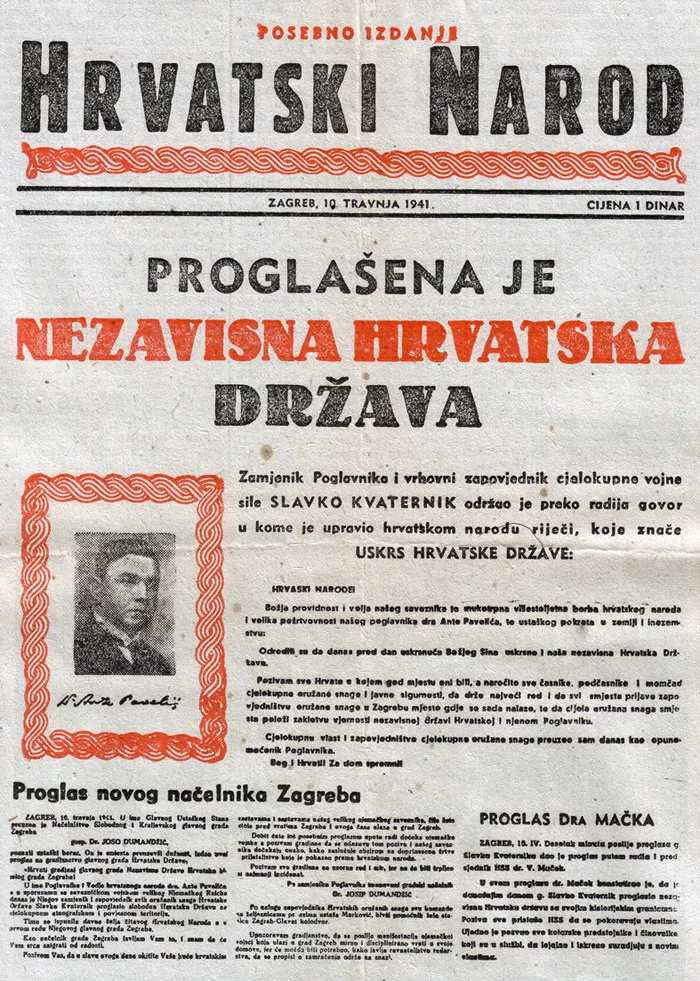
As evidenced by the historical front page of the special edition of the newspaper Hrvatski narod from April 10, 1941, Kvaternik addressed the public with words carrying a strong emotional charge, aiming at centuries-old aspirations for state independence:
“Croatian people!
Divine providence and the will of our ally, as well as the painstaking centuries-long struggle of the Croatian people – and the great self-sacrifice of our Poglavnik Doctor Ante Pavelić, and the Ustaše movement at home and abroad; have determined that today, before the day of the Resurrection of the Son of God, our Independent State of Croatia shall also rise again!
I call upon all Croats, wherever they may be, and especially all officers, non-commissioned officers, and personnel of the entire armed forces and public security, to maintain the utmost order and for all to immediately report their location to the armed forces command in Zagreb, and for the entire armed forces to immediately take the oath of loyalty to the Independent State of Croatia and its Poglavnik. I have assumed all authority and command of the entire armed forces today as the plenipotentiary of the Poglavnik!
God and the Croats! For the Homeland – ready!”
In his speech, Kvaternik used a highly symbolic connection to the upcoming Easter holiday, declaring the creation of the state a “resurrection” after, as he stated, years of foreign oppression. At the same time, the speech clearly established the political foundations of the new regime:
Dependence on the Axis powers: The phrasing “the will of our allies” openly acknowledged that the new state was created in direct agreement with and under the sponsorship of Nazi Germany and Fascist Italy.
Establishment of a dictatorship: Kvaternik announced that he was assuming all authority and command over the army immediately as the Poglavnik's plenipotentiary, making it clear from the outset that the NDH would not be a democratic republic, but an authoritarian state led by one man.
Political assurance: Proclamation of Dr. Vladko Maček
One of the most important details on the historical front page is the smaller column on the right side titled “Proclamation of Dr. Maček”.
To ensure peace and prevent resistance within the state itself, immediately after his radio proclamation, Kvaternik also read the official statement of Dr. Vladko Maček, the legitimate leader of the Croatian Peasant Party (HSS) and the former Deputy Prime Minister of the Yugoslav government. In that proclamation, Maček stated:
“Croatian people!
Colonel Slavko Kvaternik, leader of the nationalist movement in the country, has today proclaimed a free and independent Croatian state on the entire historical and geographical territory of Croatia, and has assumed power. I call upon the entire Croatian people to obey the new authority.
I call upon all supporters of the HSS who are in administrative positions, all district councilors, municipal mayors, and councilors, etc., to sincerely cooperate with the new national government.”
This statement by Maček was the decisive tipping point in the early days of the coup. Given that the HSS enjoyed massive support from the majority of the Croatian people, this appeal calmed the population, prevented mass conflict, and enabled the Ustaše structures to take over the entire administrative and police apparatus in the country without significant resistance.
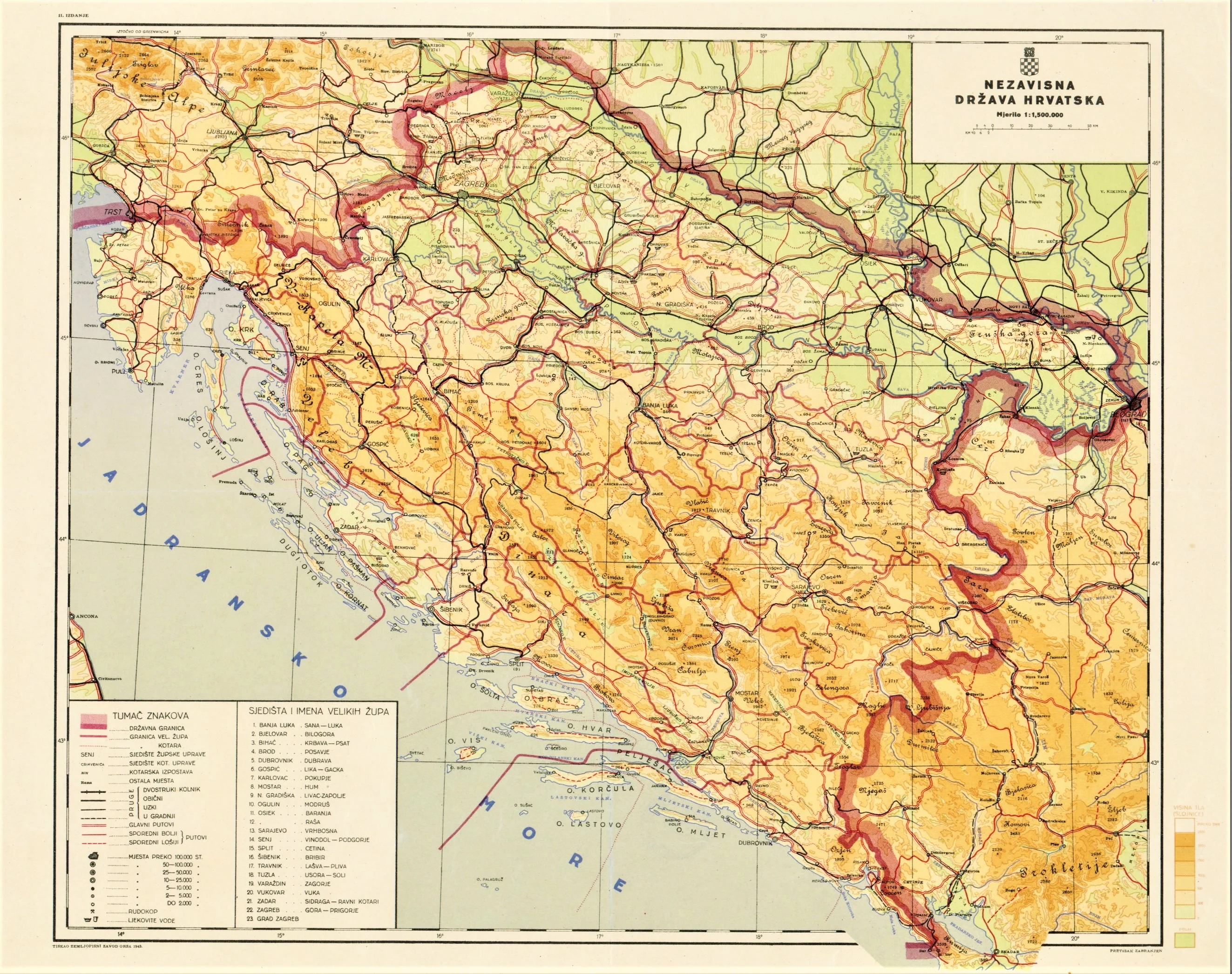
Map of the NDH from 1944 with counties
This historical map shows the administrative organisation of the Independent State of Croatia after the capitulation of Fascist Italy in September 1943. Following the Italian collapse, the Ustaše regime declared the Rome Treaties null and void and formally incorporated the Adriatic coast and islands into the state.
Key details of the map:
Division into Great Counties (Velike župe): The territory was divided into administrative units (Great Counties). The sub-Velebit coastal strip and Karlobag itself belong on this map to the Great County of Gacka and Lika, based in Gospić.
Erasure of Italian zones: The map no longer shows the earlier Italian occupation boundary, so the neighboring island of Pag is shown as part of the NDH (Great County of Sidraga-Ravni Kotari).
Propaganda versus reality: Although the map displays the full sovereignty of the NDH over the Adriatic, the reality in Karlobag was different. Control over the town and the Velebit Channel was actually immediately taken over by the German army (Wehrmacht), which turned Karlobag into its coastal fortress.
This map serves as an excellent visual source that vividly illustrates to museum visitors the gap between official state cartography in Zagreb and the actual, chaotic situation on the ground in Podgorje.
Source: Maritime and History Museum of the Croatian Littoral, Rijeka, inv. no. PPMHP 105533.
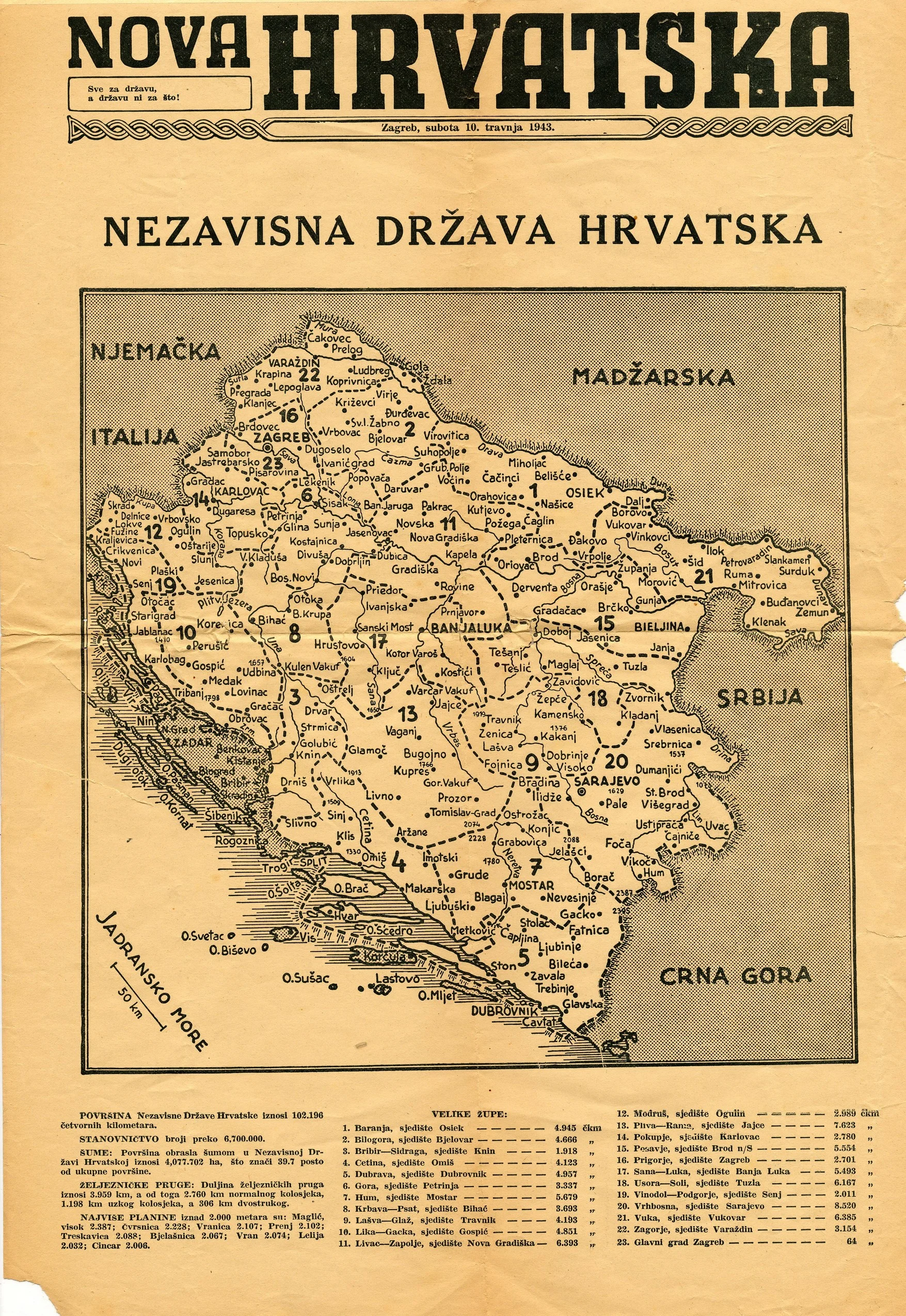
Map of the NDH from 1943.
This historical map shows the administrative organisation of the Independent State of Croatia after the capitulation of Fascist Italy in September 1943. Following the Italian collapse, the Ustaše regime declared the Rome Treaties null and void and formally incorporated the Adriatic coast and islands into the state.
Key details of the map:
Division into Great Counties (Velike župe): The territory was divided into administrative units (Great Counties). The sub-Velebit coastal strip and Karlobag itself belong on this map to the Great County of Gacka and Lika, based in Gospić.
Erasure of Italian zones: The map no longer shows the earlier Italian occupation boundary, so the neighboring island of Pag is shown as part of the NDH (Great County of Sidraga-Ravni Kotari).
Propaganda versus reality: Although the map displays the full sovereignty of the NDH over the Adriatic, the reality in Karlobag was different. Control over the town and the Velebit Channel was actually immediately taken over by the German army (Wehrmacht), which turned Karlobag into its coastal fortress.
This map serves as an excellent visual source that vividly illustrates to museum visitors the gap between official state cartography in Zagreb and the actual, chaotic situation on the ground in Podgorje.
Source: Internet Archive, digital collection.
A key historical turning point occurred on May 18, 1941, when the Ustaše regime and the Kingdom of Italy signed the infamous Rome Treaties. By this agreement, the NDH ceded the most valuable parts of the Adriatic coast to Italy, and the entire space was divided into three specific zones to organize military and civil control:
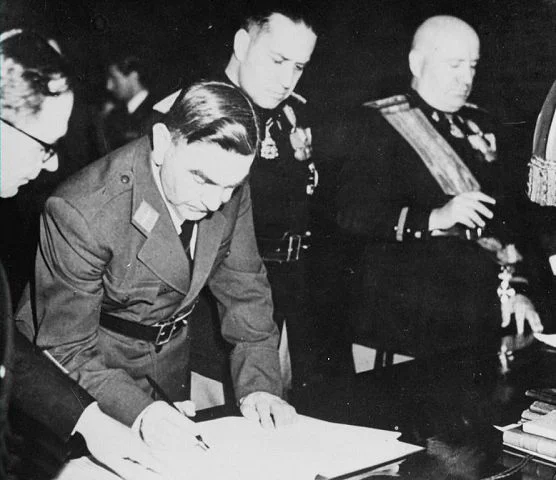
Signing of the Rome Treaties on May 18, 1941, at the Palazzo Venezia, Rome
The photograph captures the moment of the signing of the Rome Treaties at the Palazzo Venezia in Rome, May 18, 1941. The key figures visible are:
• Eugen (Dido) Kvaternik (far left, in profile with glasses) – Director of Public Order and Security of the NDH.
• Ante Pavelić (in the foreground, leaning, in uniform) – Poglavnik of the NDH, in the moment of signing the treaties by which a large part of the Adriatic coast was ceded to Italy (including the wider Podgorje/Karlobag area, which fell under the Italian occupation zone).
• Galeazzo Ciano (standing in the centre behind Pavelić) – Italian Minister of Foreign Affairs and Mussolini's son-in-law.
• Benito Mussolini (right, in uniform with a wide sash) – Fascist dictator and Prime Minister of the Kingdom of Italy, who is observing the signing.
On May 18, 1941, the so-called Rome Treaties were signed in the Roman Palazzo Venezia. The photograph records the moment when Ante Pavelić, accompanied by Italian Foreign Minister Galeazzo Ciano and under the supervision of Benito Mussolini, signs the documents by which the NDH ceded the most valuable parts of the Adriatic coast, islands, and hinterland to Italy.
For Karlobag and the entire Podgorje region, this event was fateful. By dividing the coast into occupation zones, this area became part of the First Zone (annexed territory) or the Demilitarized Zone, thus beginning a period of Italian Fascist occupation, the establishment of their military garrisons, and systematic Italianization that lasted until the capitulation of Italy in September 1943.
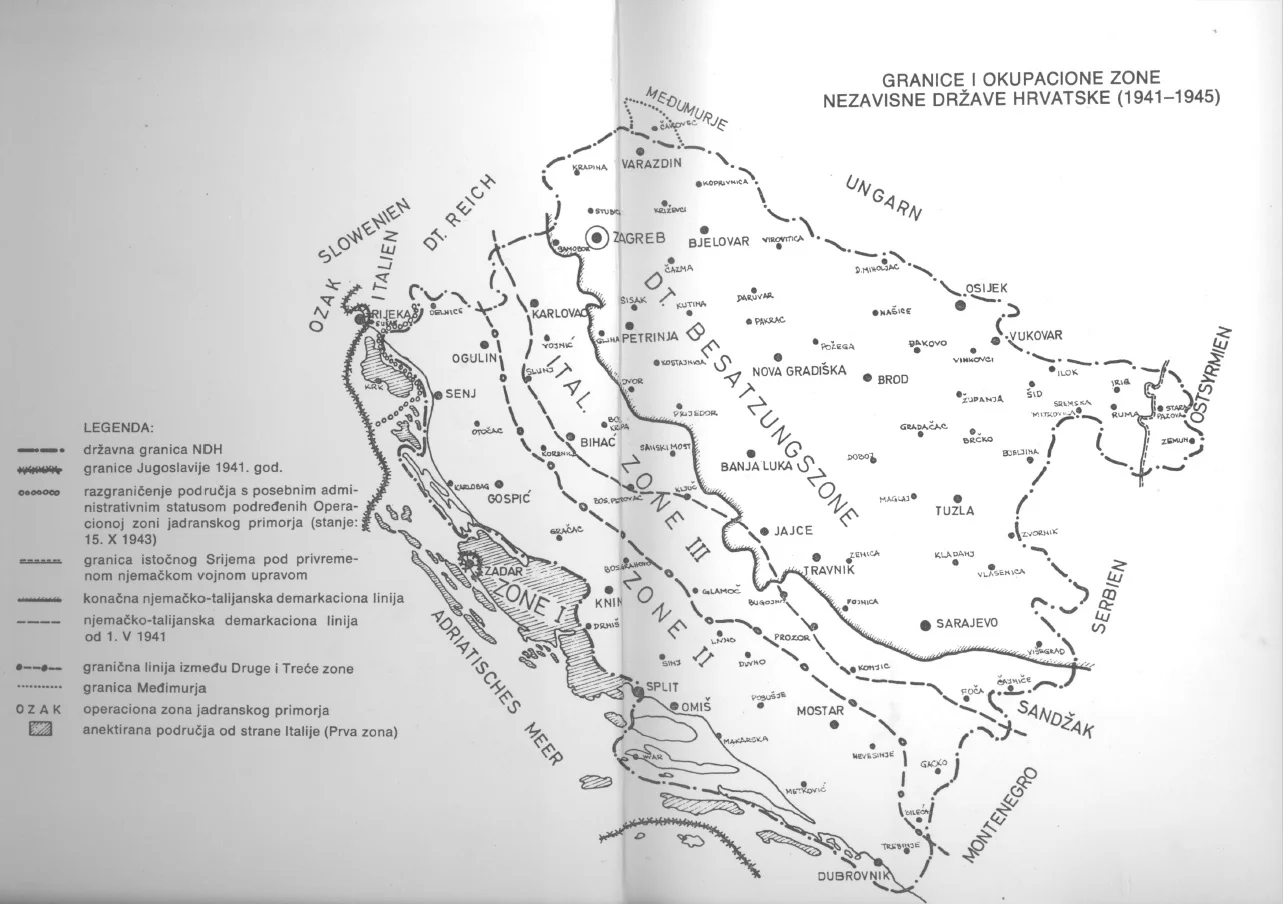
Map of Italian occupation zones after the signing of the Rome Treaties on May 18, 1941, at the Palazzo Venezia
Division of the coast and hinterland: Occupation zones and the demarcation line
This historical map vividly displays the loss of sovereignty and the complex administrative-military structure on the soil of the NDH in the period from 1941 to 1943, caused by the splitting of the territory into Italian and German spheres of influence.
Italian occupation zones: The area of the Adriatic coast, islands, and the Podgorje hinterland fell under Italian control divided into three zones. The First Zone included directly annexed areas handed over to Italy by the Rome Treaties. The Second Zone (the so-called Demilitarized Zone) and the Third Zone extended deep into the interior, across Gorski Kotar, Lika, and Bosnia, where the Italian army retained full control over military and civil life.
German occupation zone (Dt. Besatzungszone): The northern and eastern parts of the country were under the control of German military forces, separated from Italian influence by a fixed German-Italian demarcation line.
Later changes: The map also records later military realignments, such as the formation of the German Operational Zone of the Adriatic Littoral (OZAK) in the northern Adriatic after the capitulation of Italy in the autumn of 1943.
Source: Bogdan Krizman, Pavelić between Hitler and Mussolini.
Annexed Zone (First Zone) – Becomes official territory of the Kingdom of Italy under direct Italian administration. It includes parts of Gorski Kotar, the Croatian Littoral, northern and central Dalmatia (Zadar, Šibenik, Split), and most islands such as Krk, Rab, and Korčula.
Demilitarized Zone (Second Zone) – Included a wide coastal strip where Karlobag was located, the entire Velebit coastal region, and the island of Pag. This zone nominally and civilly belonged to the NDH, but the Ustaše authorities were not allowed to build fortifications, hold military units, or develop a navy in it without explicit permission from Rome. In this area, specifically on the island of Pag, the Ustaše authorities established their first concentration camps (Slana and Metajna) in June 1941.
Influence Zone (Third Zone) – Stretched deeper inland, encompassing the interior of Lika (including Gospić), Kordun, and parts of Bosnia. There, the NDH had its own civil and military authority, but the Italians retained the right of free movement and the stationing of military garrisons to secure their lines toward the sea.
The Rome Treaties, signed on May 18, 1941, at the Palazzo Venezia in Rome, represent a package of three separate agreements by which the Ustaše regime ceded to Italy sovereignty over the most valuable parts of the Adriatic coast and islands. For the area of Karlobag and the Velebit coastal region, these treaties meant the loss of military independence and the introduction of strict Italian control within the so-called Second Demilitarized Zone.
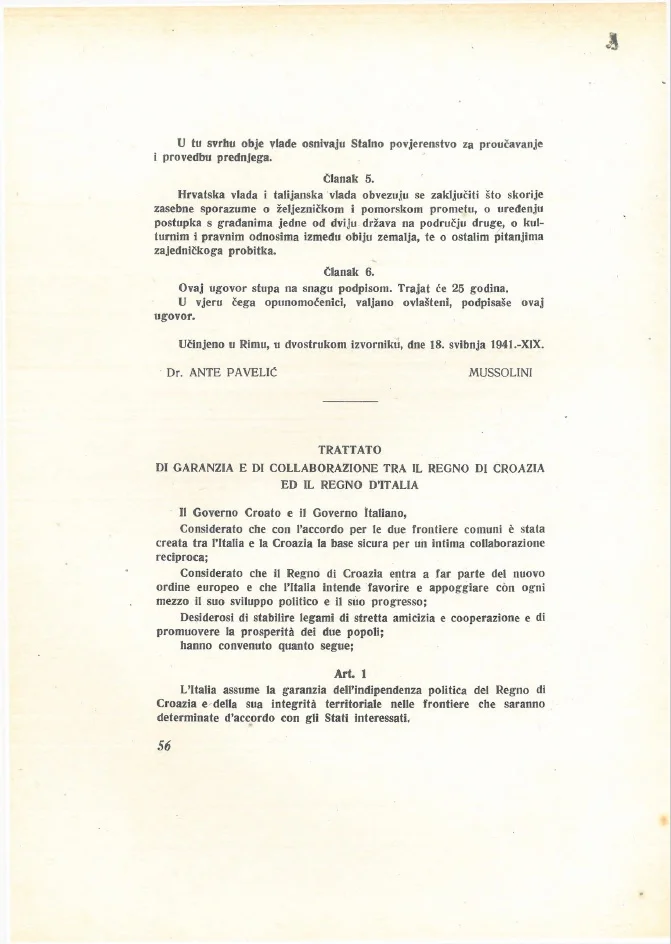
The Rome Treaties, signed on May 18, 1941, at the Palazzo Venezia in Rome, constitute a set of three independent but interconnected documents:
1. Treaty on the Determination of Borders between the Kingdom of Croatia and the Kingdom of Italy
DHM of Karlobag
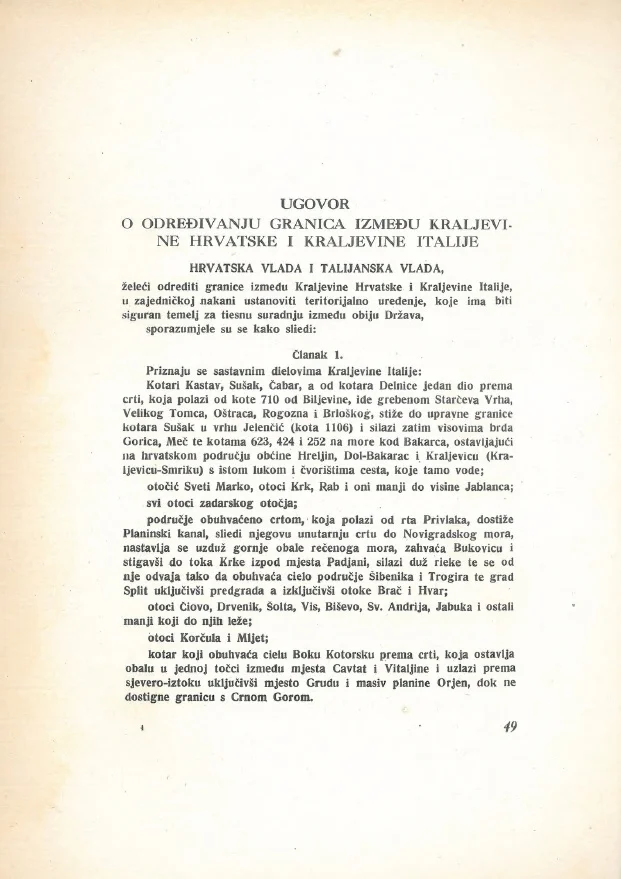
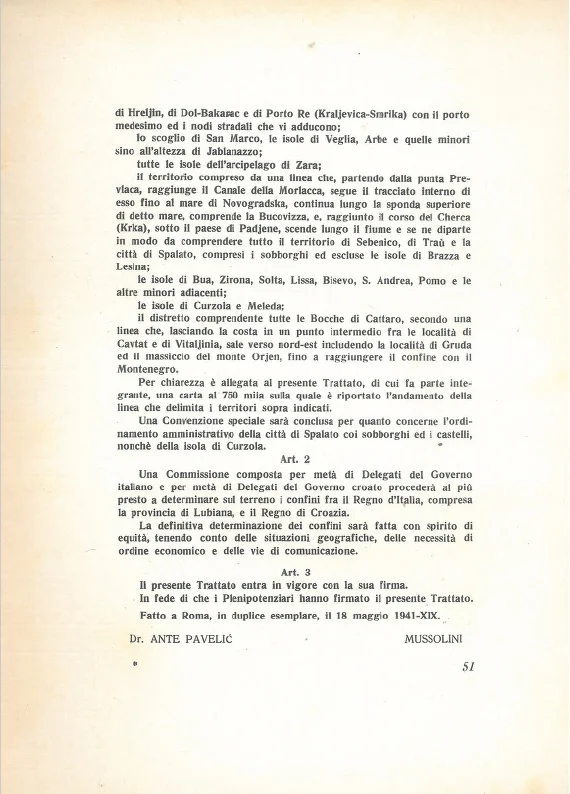
Treaty on the Determination of Borders
Date and place of enactment: Rome, May 18, 1941.
Signatories: Dr. Ante Pavelić (on behalf of the Government of the Independent State of Croatia) and Benito Mussolini (on behalf of the Government of the Kingdom of Italy).
A primary historical source that defined the territorial concessions to Fascist Italy. According to Article 1, the districts of Kastav, Sušak, Čabar, parts of Delnice, the islands of Krk and Rab, the wider area of Dalmatia (from the Planinski Channel and Zadar to Split), the islands of Šolta, Vis, Korčula, Mljet, and the Bay of Kotor were ceded to the Kingdom of Italy.
DHM of Karlobag
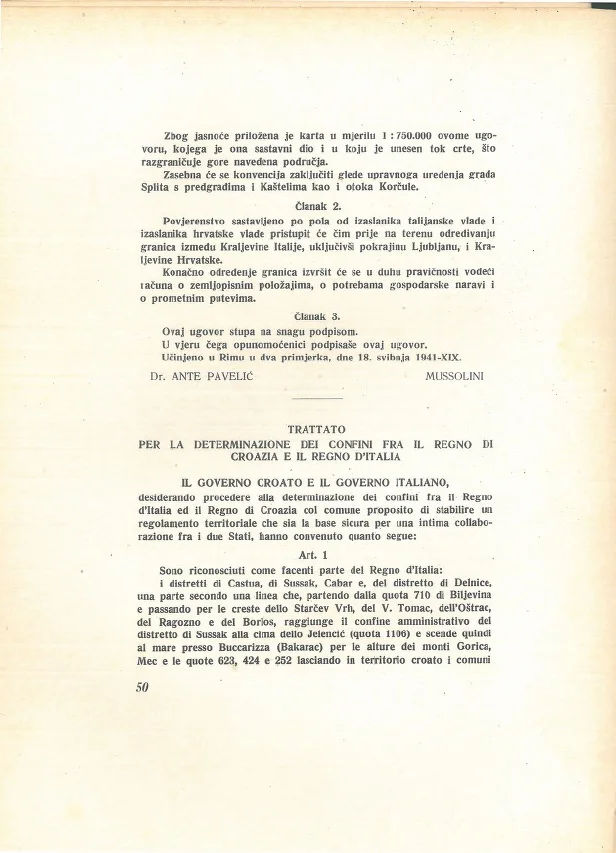
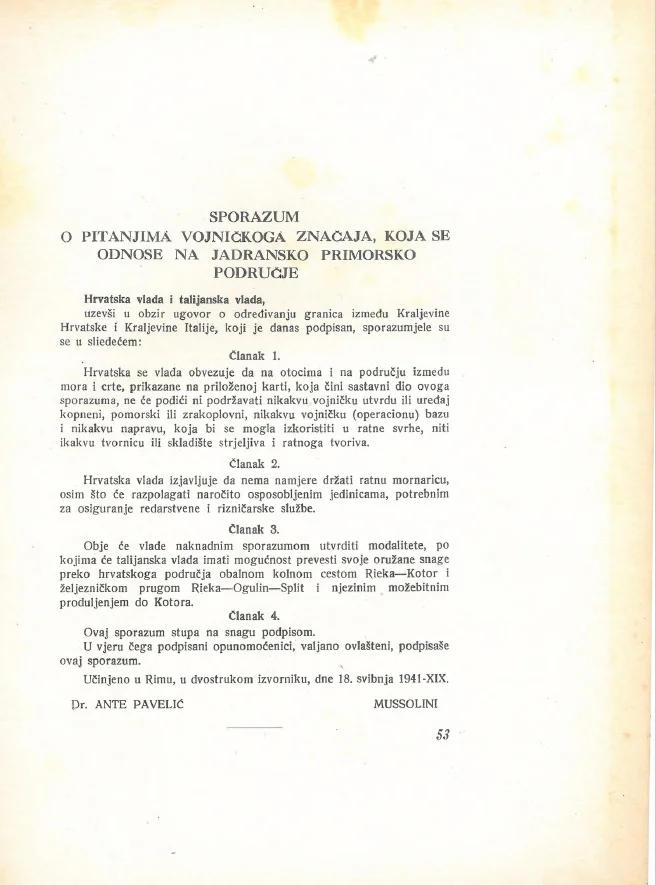
Treaty on the Determination of Borders
The displayed pages contain the text of the demarcation, the signatures of the actors in Croatian, and the beginning of the Italian version of the treaty (Trattato per la determinazione dei confini).
DHM of Karlobag
Treaty on the Determination of Borders
Additional details on the signing and ratification of the agreement in Rome.
Source: Taken from the original book “INDEPENDENT STATE OF CROATIA – MINISTRY OF FOREIGN AFFAIRS – INTERNATIONAL TREATIES 1941.”
2. Agreement on Matters of Military Significance Relating to the Adriatic Coastal Area
DHM of Karlobag
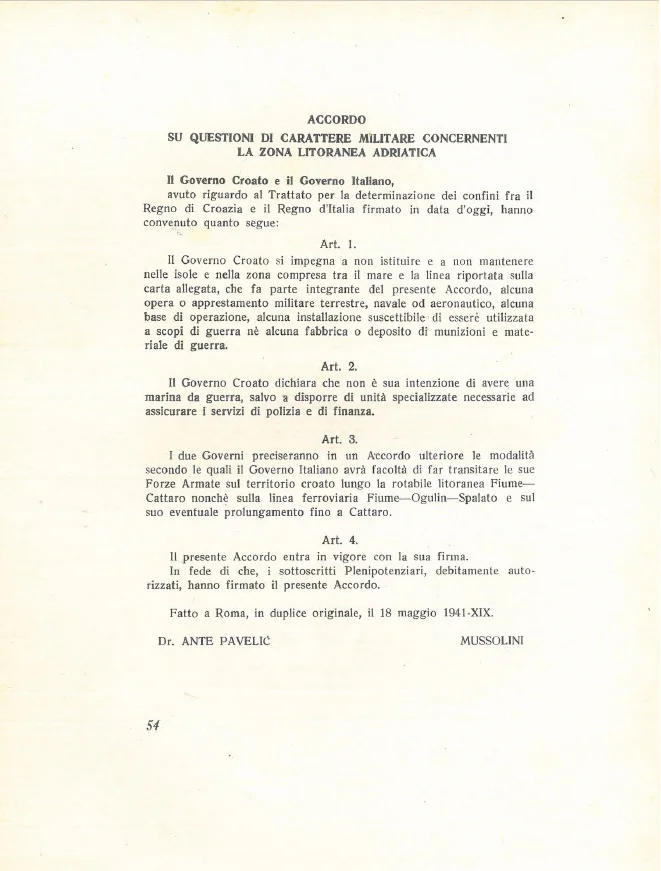
Agreement on Military Matters
Date and place of enactment: Rome, May 18, 1941.
A primary historical source displaying provisions on the demilitarization of the Adriatic coastal strip and islands. According to Articles 1 and 2 of this agreement, the Croatian side committed not to build military fortifications, operational bases, or military facilities in that area.
DHM of Karlobag
Agreement on Military Matters
Provisions on the renunciation of maintaining a navy (except for police and patrol service units).
Source: Taken from the original book “INDEPENDENT STATE OF CROATIA – MINISTRY OF FOREIGN AFFAIRS – INTERNATIONAL TREATIES 1941.”
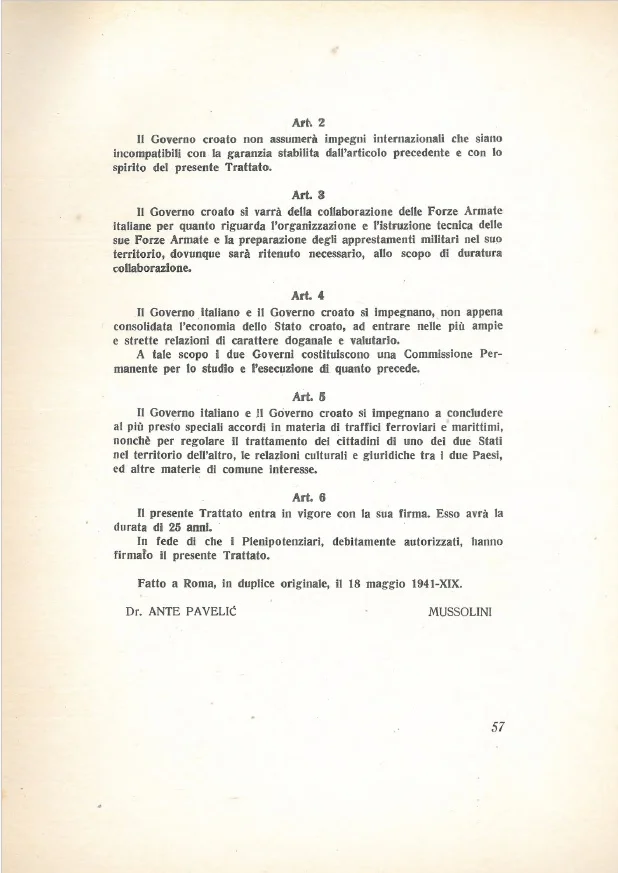
3. Treaty of Guarantee and Cooperation between the Kingdom of Croatia and the Kingdom of Italy
DHM of Karlobag
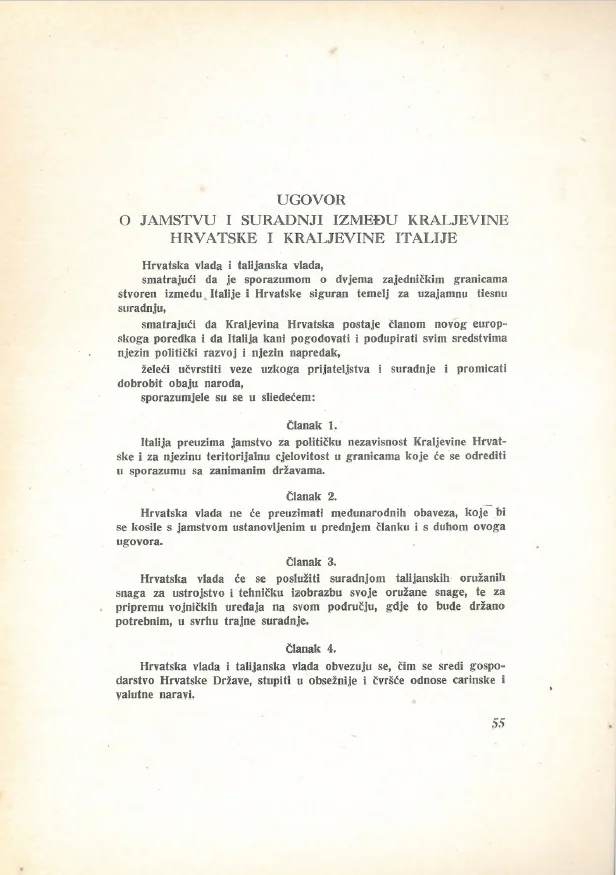
Treaty of Guarantee and Cooperation
Date and place of enactment: Rome, May 18, 1941.
A primary historical source that defines the political-legal relations and the subordination of the NDH to Italian interests. According to the treaty, Italy assumes a guarantee for the political independence and territorial integrity of Croatia (Art. 1).
DHM of Karlobag
Treaty of Guarantee and Cooperation
The Croatian government undertakes not to assume international obligations that would conflict with this guarantee (Art. 2) and agrees to cooperate with Italian armed forces.
DHM of Karlobag
Treaty of Guarantee and Cooperation
The treaty was signed for a period of 25 years (Art. 6).
Source: Taken from the original book “INDEPENDENT STATE OF CROATIA – MINISTRY OF FOREIGN AFFAIRS – INTERNATIONAL TREATIES 1941.”
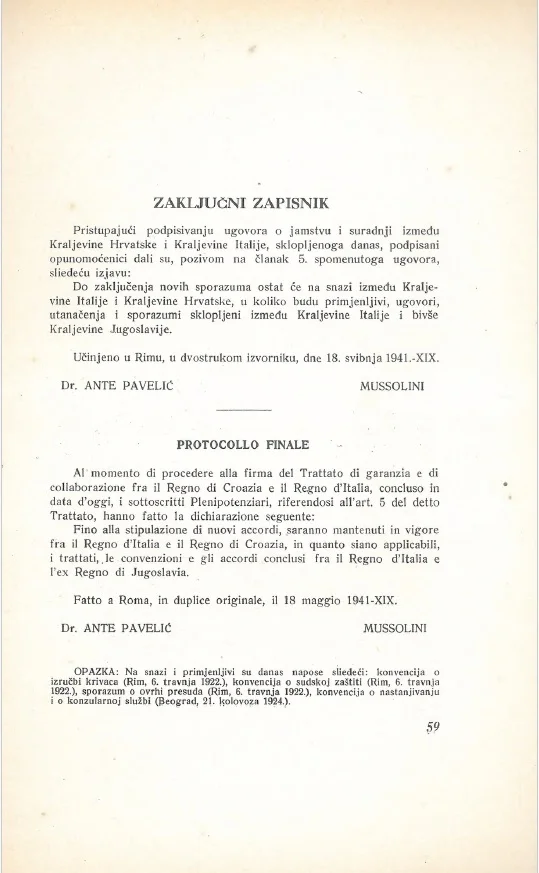
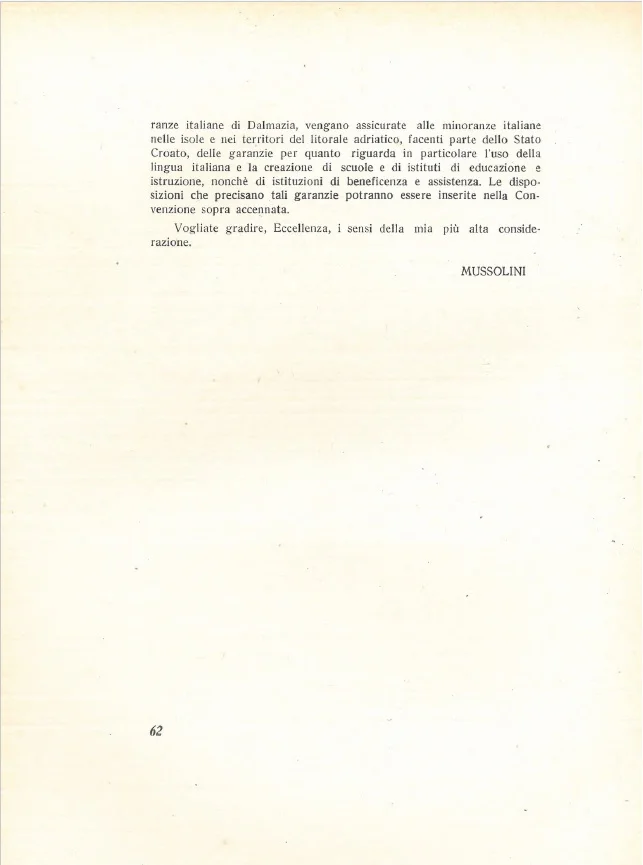
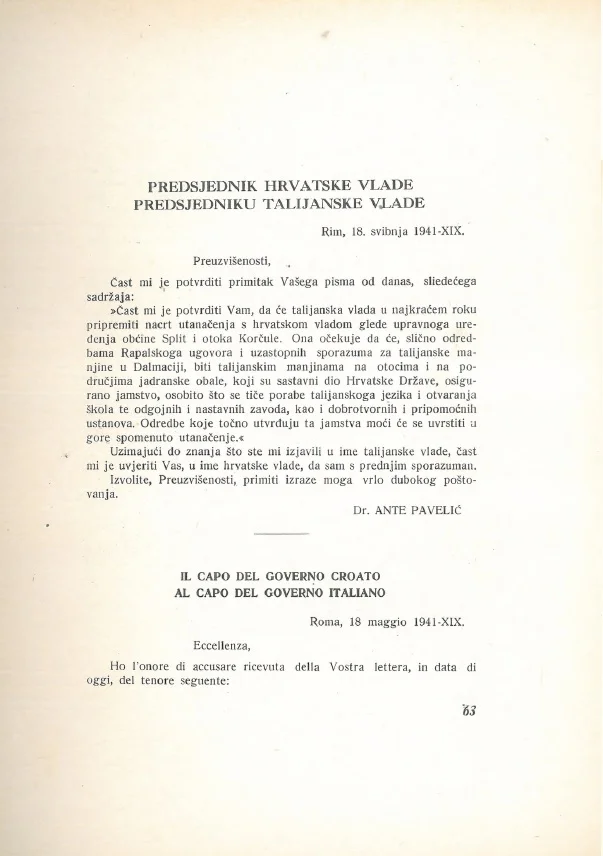
Final Protocol and address from one government to another
DHM of Karlobag
Final Protocol
This document represents a historical archival source, specifically the Final Protocol (Italian: Protocollo finale), which is an integral part of the Rome Treaties concluded on May 18, 1941, in Rome.
DHM of Karlobag
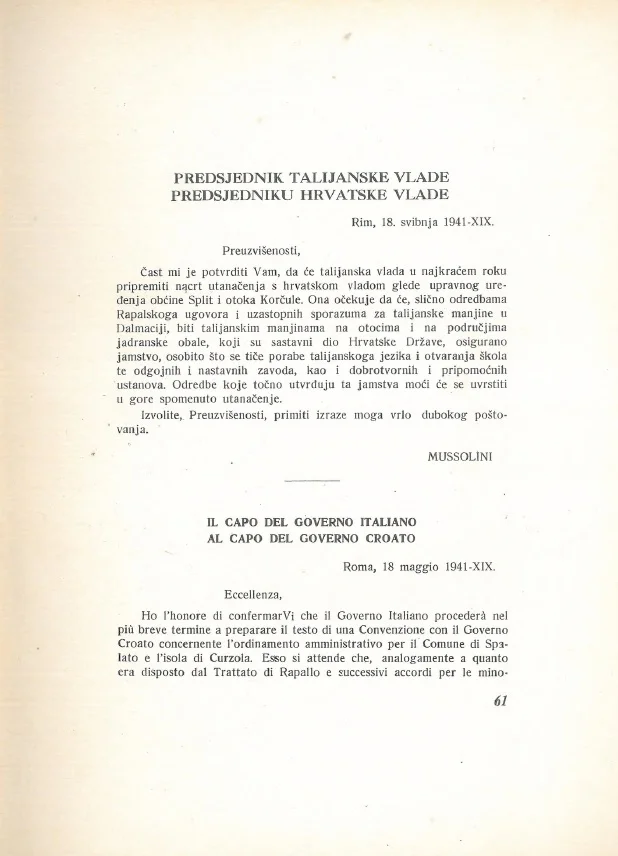
Mussolini's Address
The document represents an official diplomatic note (letter) sent by Benito Mussolini, as Prime Minister of the Italian government, to Ante Pavelić.
DHM of Karlobag
Mussolini's Address
Continuation of the official diplomatic note of Benito Mussolini from May 1941.
Source: Taken from the original book “INDEPENDENT STATE OF CROATIA – MINISTRY OF FOREIGN AFFAIRS – INTERNATIONAL TREATIES 1941.”
DHM of Karlobag
Pavelić's Address
The document represents an official diplomatic note (reply) that Ante Pavelić, as Prime Minister of the Croatian government, sent to Benito Mussolini.
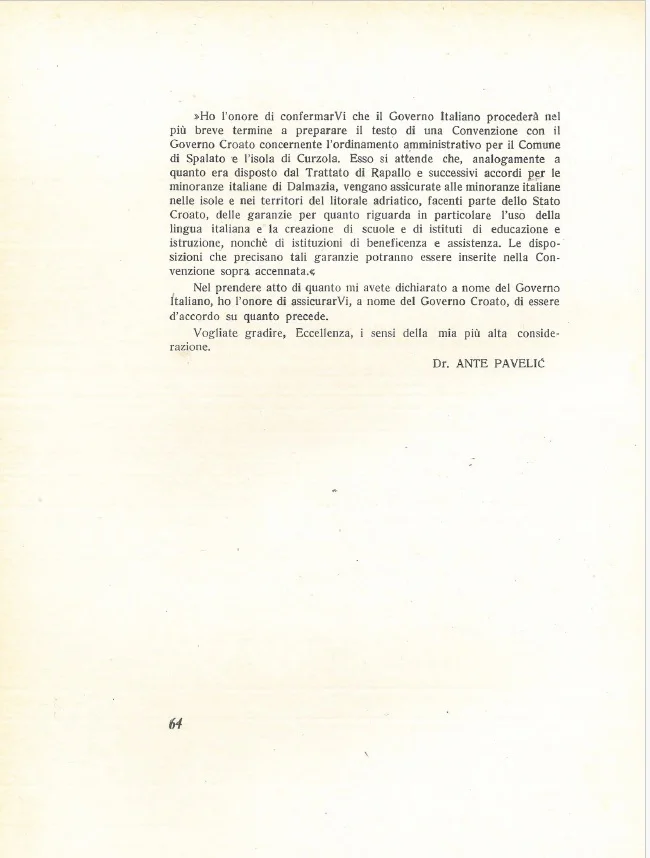
DHM of Karlobag
Pavelić's Address
The document is a direct continuation and legal response to Mussolini's letter.
Source: Taken from the National Archives of the United Kingdom, inv. no. AIR 23/8247.
2. Arrival of the Italians: Reoccupation of the Second Zone (Autumn 1941)
Due to mass Ustaše terror against the population, a major popular uprising erupted in Lika as early as the summer of 1941. Since the NDH authorities were unable to control the situation and pacify the hinterland, Fascist Italy seized the opportunity to realize its true ambitions – complete military control over the eastern Adriatic coast.
In August and September 1941, the Italian army carried out the military reoccupation of the Second Zone. Italian units (V Army Corps) marched into Karlobag, assumed full military authority, and disarmed or drastically restricted local Ustaše garrisons. In order to suppress the uprising and establish control, the Italians disbanded and closed the Ustaše camps of Slana and Metajna on the island of Pag in August 1941, which had functioned as the island part of the wider and infamous Gospić–Jadovo–Pag Ustaše camp system. From that moment, Karlobag became a key Italian naval and land base for controlling the channel and securing the strategic road across Velebit toward Baške Oštarije.
3. Italian Capitulation and Political Absurdity (September 1943)
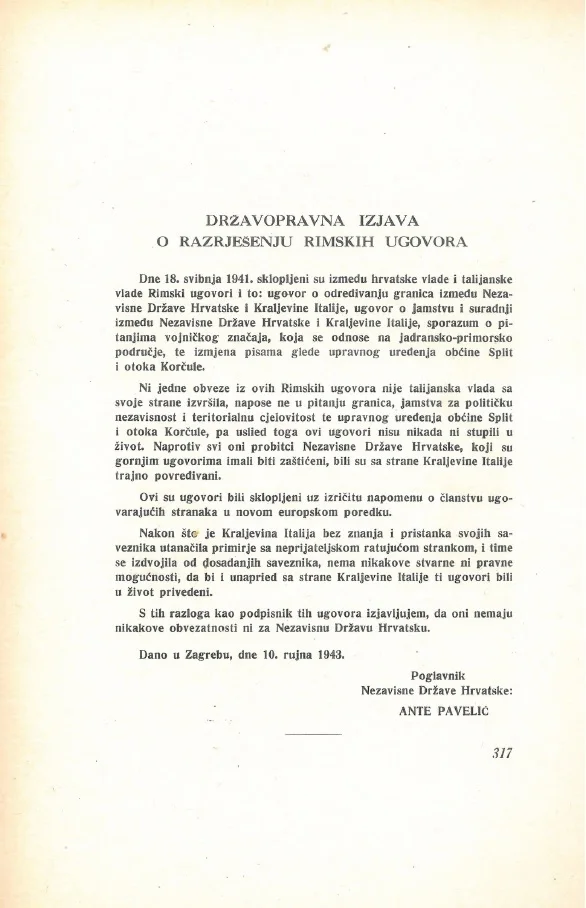
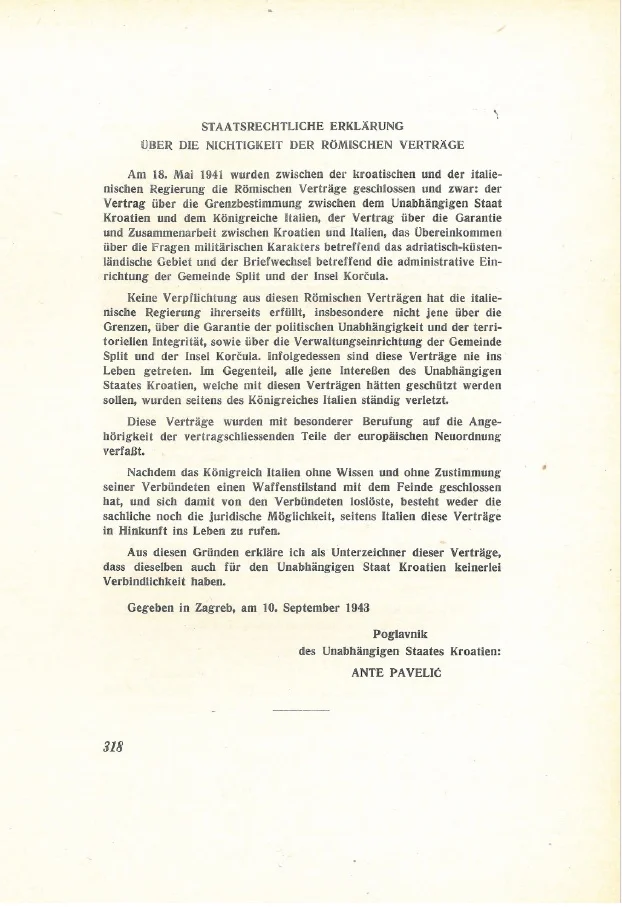
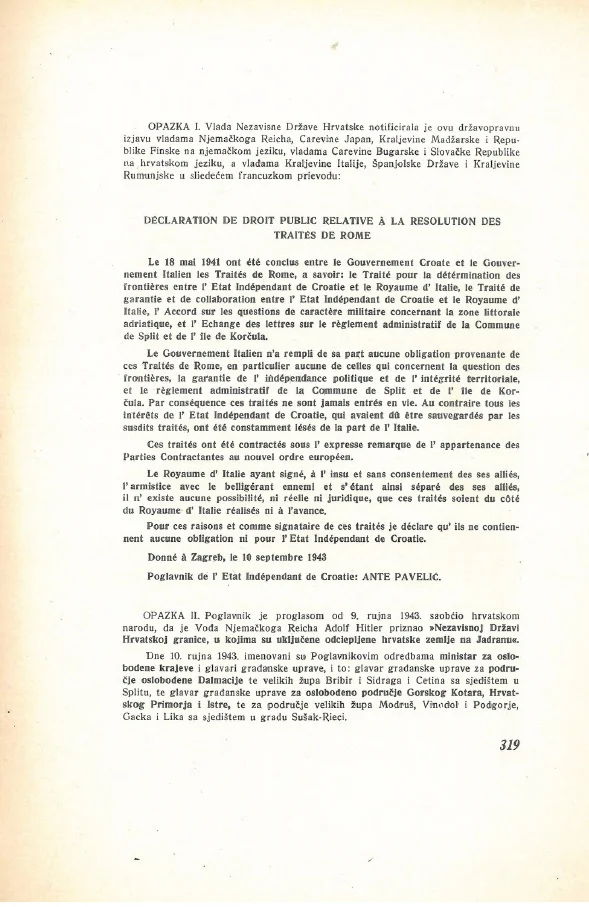
The Italian dictatorship on the Adriatic was shattered on September 8, 1943, by the capitulation of Italy. While the Italian army fled from Karlobag and Pag in disarray, Ante Pavelić signed the official Declaration on the Annulment of the Rome Treaties in Zagreb on September 10, 1943, declaring them null and void.
This State-Legal Declaration, signed by Ante Pavelić on September 10, 1943 – two days after the capitulation of Fascist Italy – is the formal act by which the Ustaše regime declared the Rome Treaties null and void. In the text, the blame for the collapse of the treaties is placed exclusively on the Italian side, arguing that Italy failed to fulfill its obligations to guarantee sovereignty and that by signing the armistice with the Allies, it violated the Pact of the Axis powers.
DHM of Karlobag
State-Legal Declaration (p. 1)
Date and place of enactment: Zagreb, September 10, 1943.
Before you is a facsimile of the official proclamation of the Ustaše regime by which the Rome Treaties of May 1941 were declared null and void. The document is signed in three languages by the Poglavnik of the NDH, Ante Pavelić.
DHM of Karlobag
State-Legal Declaration (p. 2)
In the text of this declaration, the Ustaše leadership legally justifies the termination of the treaty by claiming that the Italian government failed to fulfill any of its assumed obligations.
DHM of Karlobag
State-Legal Declaration (p. 3)
The signing of the Italian armistice with the Allies was used as the formal pretext to declare the treaties permanently invalid.
Source: Taken from the original book “INDEPENDENT STATE OF CROATIA – MINISTRY OF FOREIGN AFFAIRS – INTERNATIONAL TREATIES 1943.”
DHM of Karlobag
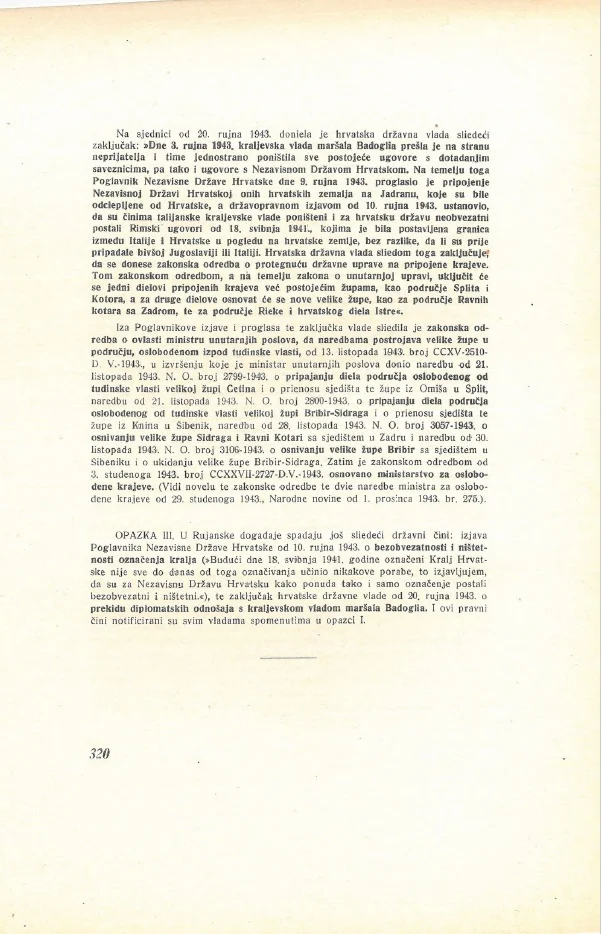
Collection of Regulations on Reorganization
Exhibit: Legal-administrative acts on the reorganization of Adriatic territories after the capitulation of Italy (September – November 1943).
Before you is a page from the official collection of regulations and legal provisions of the NDH from the autumn of 1943. The text documents in detail the administrative steps with the proclaimed goal of formal annexation and organisation of the "liberated territories" on the Adriatic.
Source: Taken from the original book “INDEPENDENT STATE OF CROATIA – MINISTRY OF FOREIGN AFFAIRS – INTERNATIONAL TREATIES 1943.”
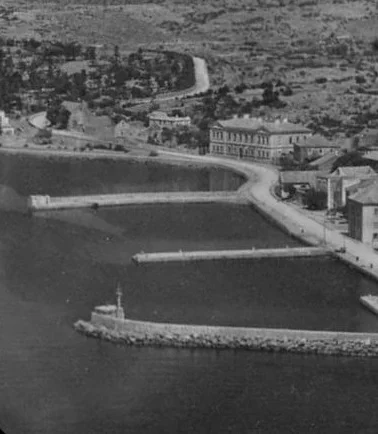
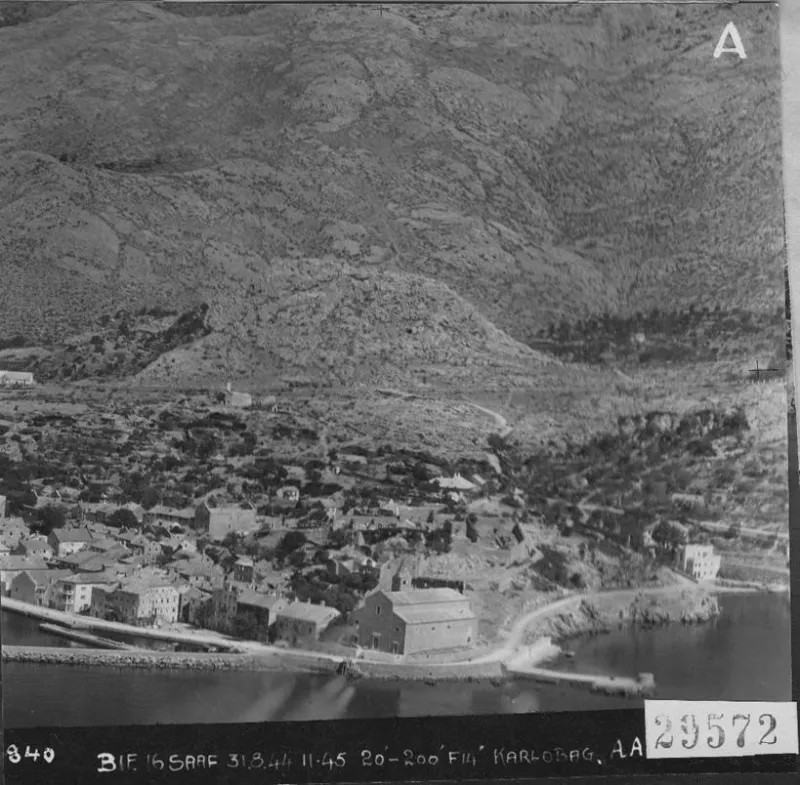
However, the reality on the ground was completely different from the proclamations in Zagreb. The NDH had neither the manpower nor the military strength to actually occupy and defend the coast. The German army (Wehrmacht) immediately launched operations to occupy the Adriatic coast to prevent any potential Allied landings. Karlobag again fell under foreign military control – this time under the authority of the German XV Mountain Army Corps. Working with smaller Ustaše units, the Germans converted the town into a fortified coastal stronghold (Stützpunkt). They built defensive positions and bunkers at key points, including a concrete bunker near the lighthouse at the very tip of the main pier.
Aerial photograph taken during an attack by the Balkan Air Force (BAF) in 1944. The bunker on the tip of the breakwater is visible in the image.
Although the proclamation was formally intended to mean the return of the seized Adriatic territories, islands, and the coastal belt below Velebit (including Karlobag) to the civil and military authority of Zagreb, the reality on the ground was significantly different. Instead of the NDH assuming actual sovereignty, the entire area was immediately occupied by German forces (Wehrmacht) as part of Operation Achse, turning Karlobag into one of their key coastal fortifications in Podgorje. The document therefore vividly illustrates the enormous gap between the proclaimed legal status and the actual German military administration on the Adriatic.
4. The Drama of Delay and Allied Bombings (End of 1944)
By the end of 1944, the pressure on German forces in the Velebit Channel became unbearable. In order to cut supply lines and enable the seizure of control over the coast, partisan forces (including dispatches from the 4th Corps and the Main Staff) sent dramatic requests to the British Air Force (RAF) for urgent bombing of German strongholds in Karlobag and Pag.
Archival documents from December 1944 reveal a true military drama: attacks on Karlobag and Pag were requested repeatedly, but were postponed for days due to extremely unfavorable weather conditions (the Velebit bora in the channel and poor visibility) and the need for more precise reconnaissance of the terrain.
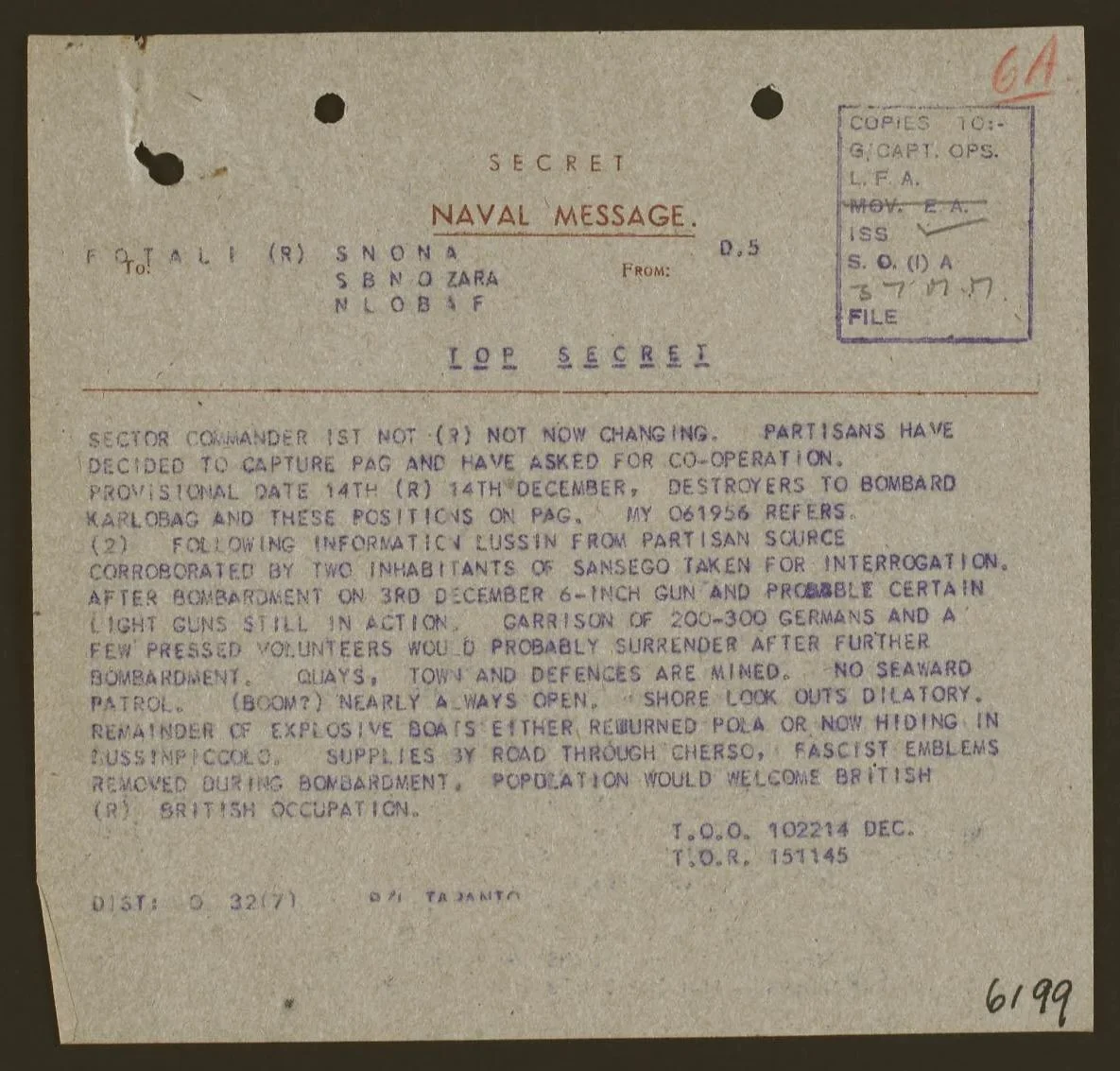
This original document of the British Royal Navy from December 1944 bears witness to the direct tactical coordination between partisan forces and the Allies on the Adriatic Sea. The dispatch explicitly states that the partisans made the decision to occupy the island of Pag and requested military cooperation from British forces.
As a direct response to that request, an order was issued to Allied destroyers to bombard German positions in Karlobag and strategic strongholds on Pag ("Destroyers to bombard Karlobag and these positions on Pag").
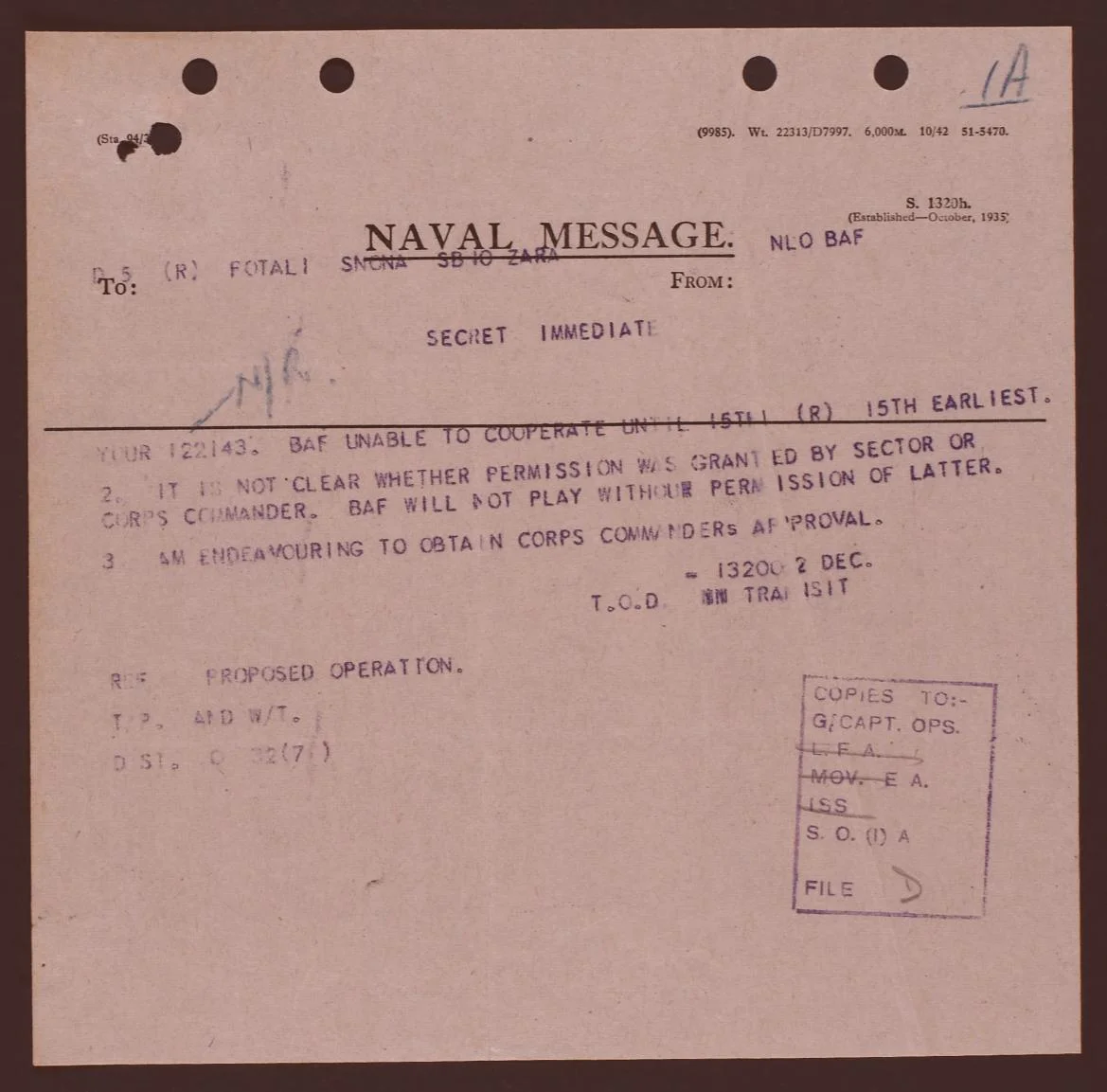
This urgent naval message sent to the liaison officer of the Balkan Air Force (NLO BAF) reveals the complexity and drama of warfare in the specific Adriatic terrain. The document records a key moment in which the Allied command reports unfavorable news: the air force (BAF) is temporarily unable to provide support to the partisans in the attack.
The main causes for the delay were the raging Velebit bora in the channel and extremely poor visibility, which pinned Allied aircraft to the ground.
Source: Taken from the National Archives of the United Kingdom, inv. no. AIR 23/8247.
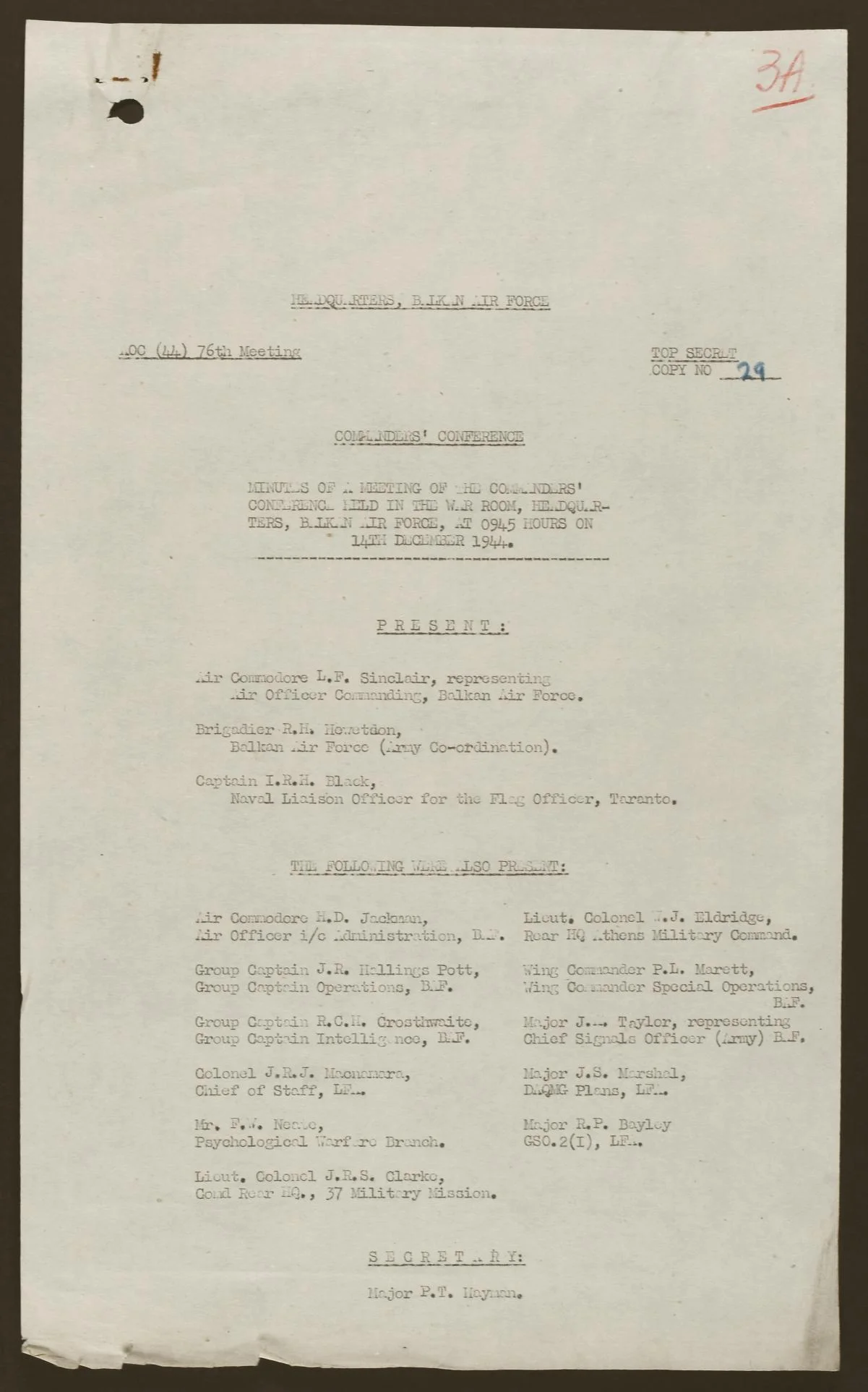
Minutes from a secret conference of the Allied air forces (Balkan Air Force) held on December 24, 1944. The document provides a list of the high-ranking military commanders and intelligence officers present who coordinated and approved air operations in the Adriatic area at the end of the Second World War.
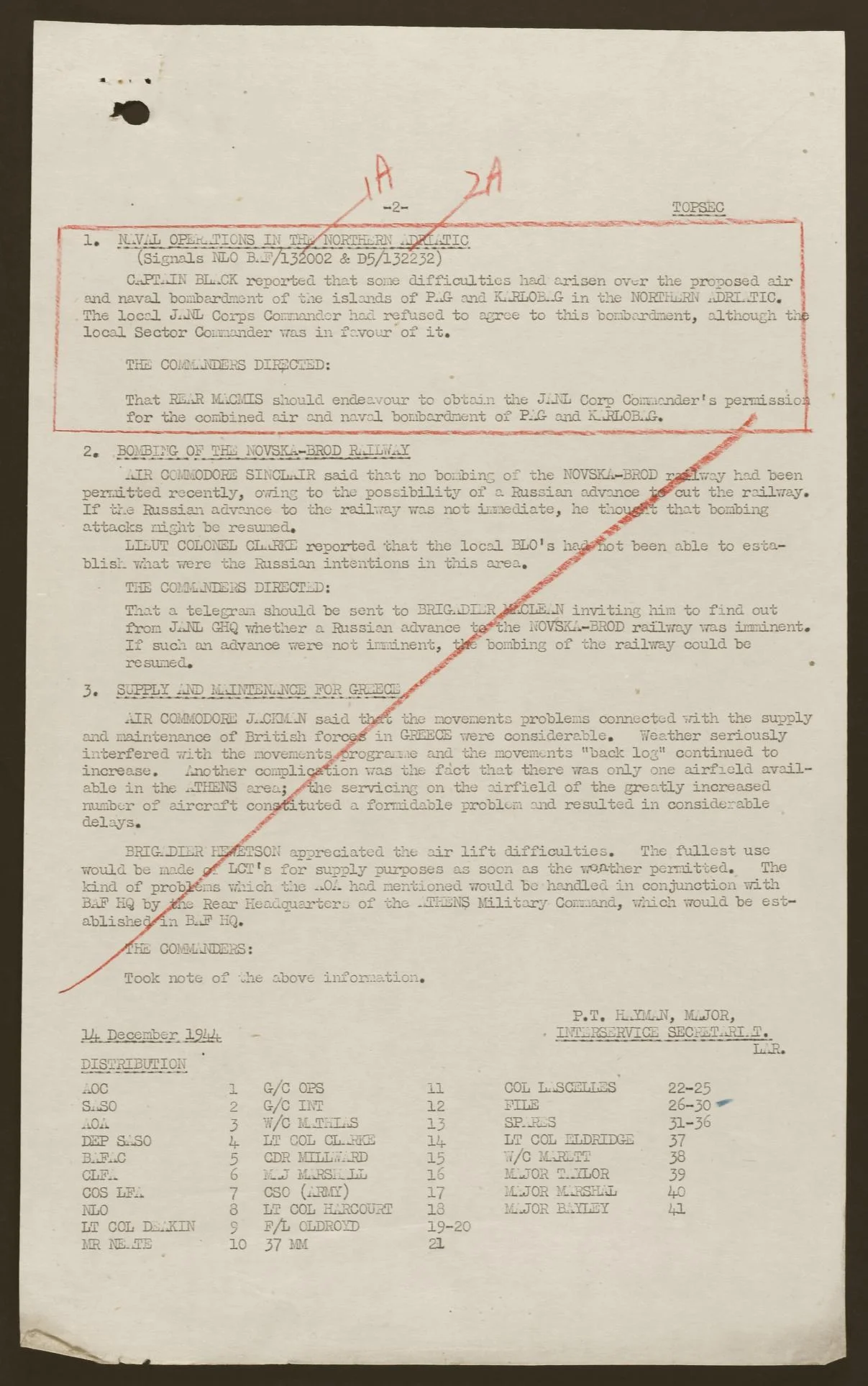
Top-secret plan for the bombing of Podgorje (circled part). The red rectangle contains a discussion regarding a proposed combined air and naval attack on the Pag and Karlobag strongholds ("bombardment of PAG and KARLOBAG") in the northern Adriatic. These documents directly bear witness to the cold military strategy that resulted in the heavy destruction of the historical core of Karlobag at the end of 1944.
Source: Taken from the National Archives of the United Kingdom, inv. no. AIR 23/8247.
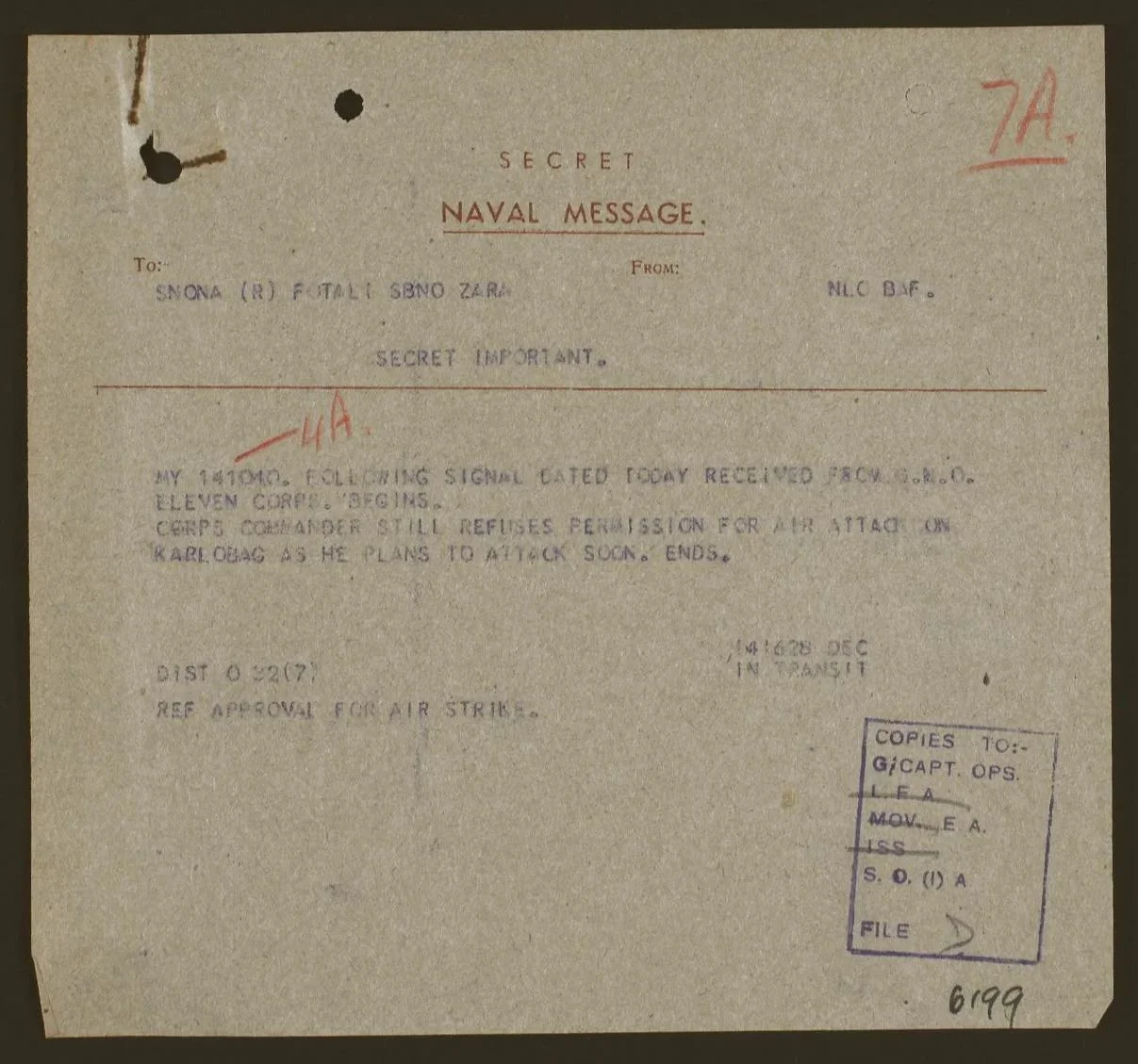
Although sent via the naval communication network (Naval Message), this secret dispatch actually testifies to the strict coordination between ground forces and the air force. The naval liaison officer at the Balkan Air Force (NLO BAF) conveys the order of the commander of the 11th Corps (NOVJ), who is temporarily refusing to grant permission for an air attack on Karlobag.
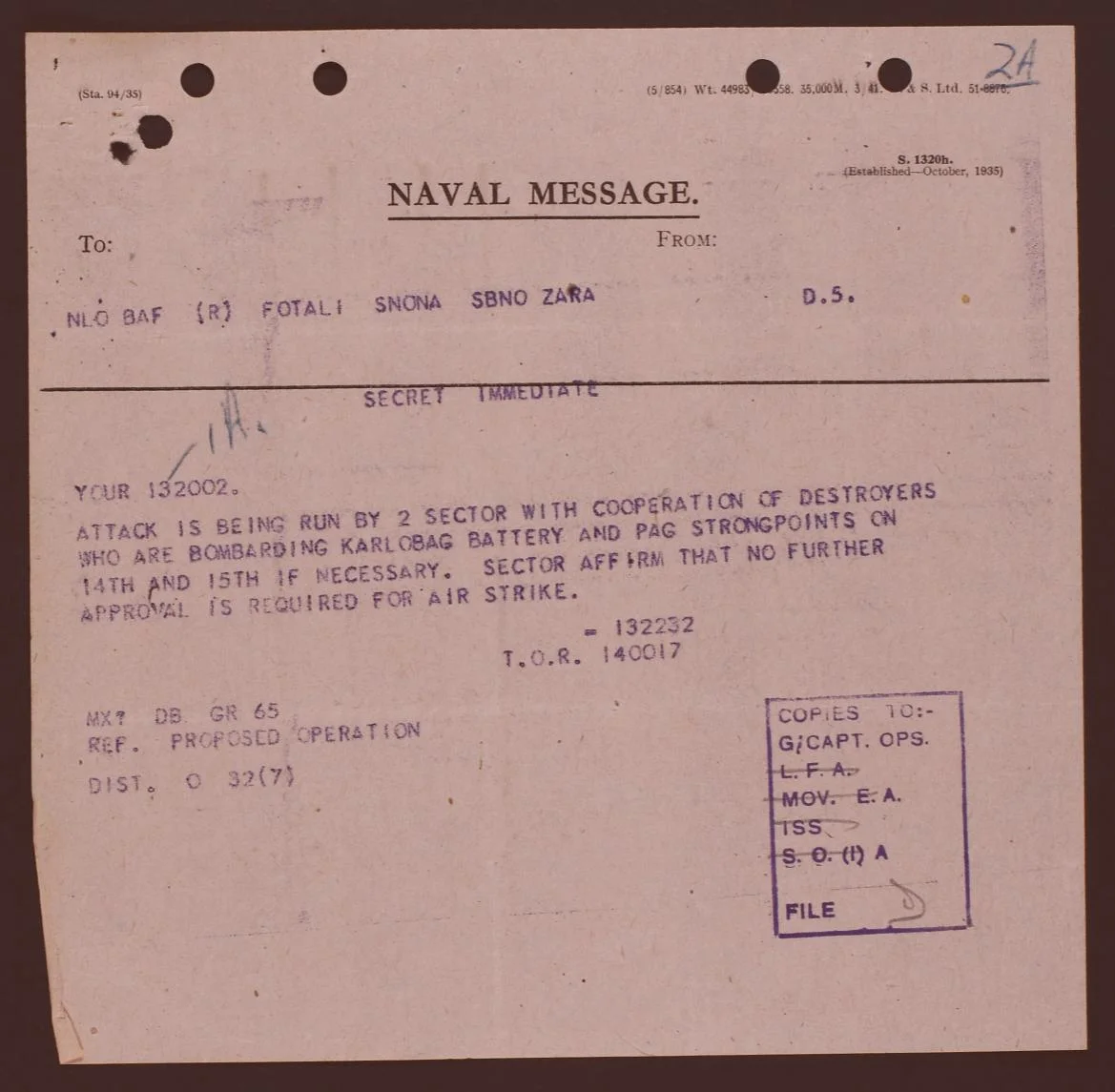
This urgent dispatch documents the launch of a joint Allied operation on the Velebit Channel. The text reveals direct tactical cooperation between the navy and the air force: Allied destroyers ("destroyers") began artillery bombardment of German coastal batteries in Karlobag and fortified points on the island of Pag.
Source: Taken from the National Archives of the United Kingdom, inv. no. AIR 23/8247.
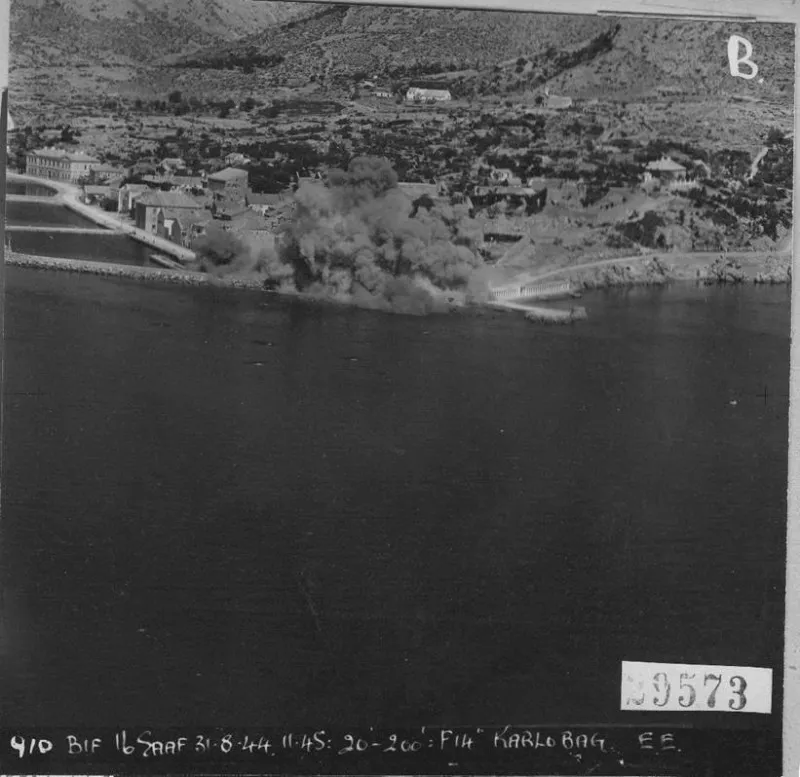
A unique historical photograph of the bombing of the Church of St. Charles Borromeo, taken from an attack aircraft of the 16th Squadron of the South African Air Force (16 SAAF) as part of the Balkan Air Force (BAF) during an earlier attack on August 31, 1944, serves as testament to these air operations. The moment of the rocket attack on the church is clearly visible in it. These attacks caused demolition and material damage to individual buildings in the town, but Karlobag ultimately escaped the fate of total destruction experienced by some other Adriatic cities (such as Zadar).
Aerial footage during the attack by the Balkan Air Force (SAAF - South African Air Force) in 1944, which was part of these BAF air forces at the time.
Aerial footage during the attack by the Balkan Air Force (SAAF - South African Air Force) in 1944, which was part of these BAF air forces at the time.
5. Departure of the Germans and Arrival of the Partisans (April 1945)
In the spring of 1945, the final operations for the liberation of the Adriatic coast began. Under strong pressure from the 4th Army of the Yugoslav Army (JA), German and Ustaše forces were forced to retreat along the coastal route toward Rijeka and Istria in April 1945.
Partisan units entered Karlobag, bringing an end to a four-year period of constant shifts in authority, repression, and occupation. The town emerged from the war with visible scars on its historical core, but ready for the long-term post-war reconstruction that would permanently change the profile and social life of Karlobag in the coming decades.
HISTORICAL SOURCE · SECOND WORLD WARHistorical document