
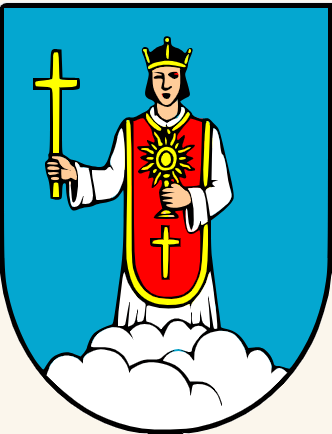
Bag’s Inherited Rights
When Bag came under Matthias Corvinus in the late fifteenth century, its rights did not begin with the new ruler. Matthias’s charter of 1481 preserves an earlier layer of the town’s legal history: charters and confirmations issued under the Kurjaković counts of Krbava in 1387, 1432 and 1451. They record the rights, liberties, customs, boundaries, judicial arrangements and other affairs of the community of Scrisia, or Bag.
Matthias’s confirmation of 1481 incorporates the texts of the charters of 1387, 1432 and 1451. Their full English translation accompanies the manuscript copy. A separate chapter on Karlobag under the Kurjaković Family provides their wider historical context and the family’s genealogy.
Surviving Copies and the Printed Edition
The text of Matthias’s charter of 1481 survives in later manuscript copies and was published in the nineteenth century by Ivan Kukuljević Sakcinski. Presented here are two copies from the Archives of the Croatian Academy of Sciences and Arts and the published Latin text from Jura Regni Croatiae, Dalmatiae et Slavoniae.
1. Bag under Matthias Corvinus
Following the death of King Ladislaus V the Posthumous, the throne stood vacant. Matthias, the younger son of John Hunyadi, was supported by his mother, Elizabeth Szilágyi, his uncle, Michael Szilágyi, Bishop John Vitéz of Sredna, and many lesser nobles who wanted a native ruler. At the Diet held in Buda and Pest on 24 January 1458, Matthias was elected King of Hungary and Croatia. Since the Crown of Saint Stephen was held by Emperor Frederick III, his formal coronation did not take place until 29 March 1464.
During his reign, Matthias Corvinus sought to restore royal authority and direct control over important towns in the Kingdom of Croatia. Bag, the medieval Scrissa, had long been ruled by the Kurjaković counts of Krbava. By 1481 at the latest, the town had come under Matthias’s direct rule, although the known sources do not explain how the transfer took place.
Vjekoslav Klaić suggests that Maroje Zunjević, the king’s chief captain of Senj, Novi and Bribir, may have contributed to this change. Klaić explicitly writes “perhaps”, so it cannot be asserted that Zunjević captured Bag or that the town was taken in a siege or battle. What is certain is that Bag passed from Kurjaković rule to direct royal administration.
The royal charter of 21 December 1481 is particularly important for the town’s history. The new ruler was asked to confirm the rights that the community of Bag had enjoyed before the change of authority. Matthias did not establish Bag’s privileges anew, but confirmed its earlier rights and boundaries through his royal authority.
Source: Vjekoslav Klaić, Povijest Hrvata, treća knjiga: Doba kralja Matijaša Korvina i Jagelovića (1458.–1526.), pp. 4–8 and 118.
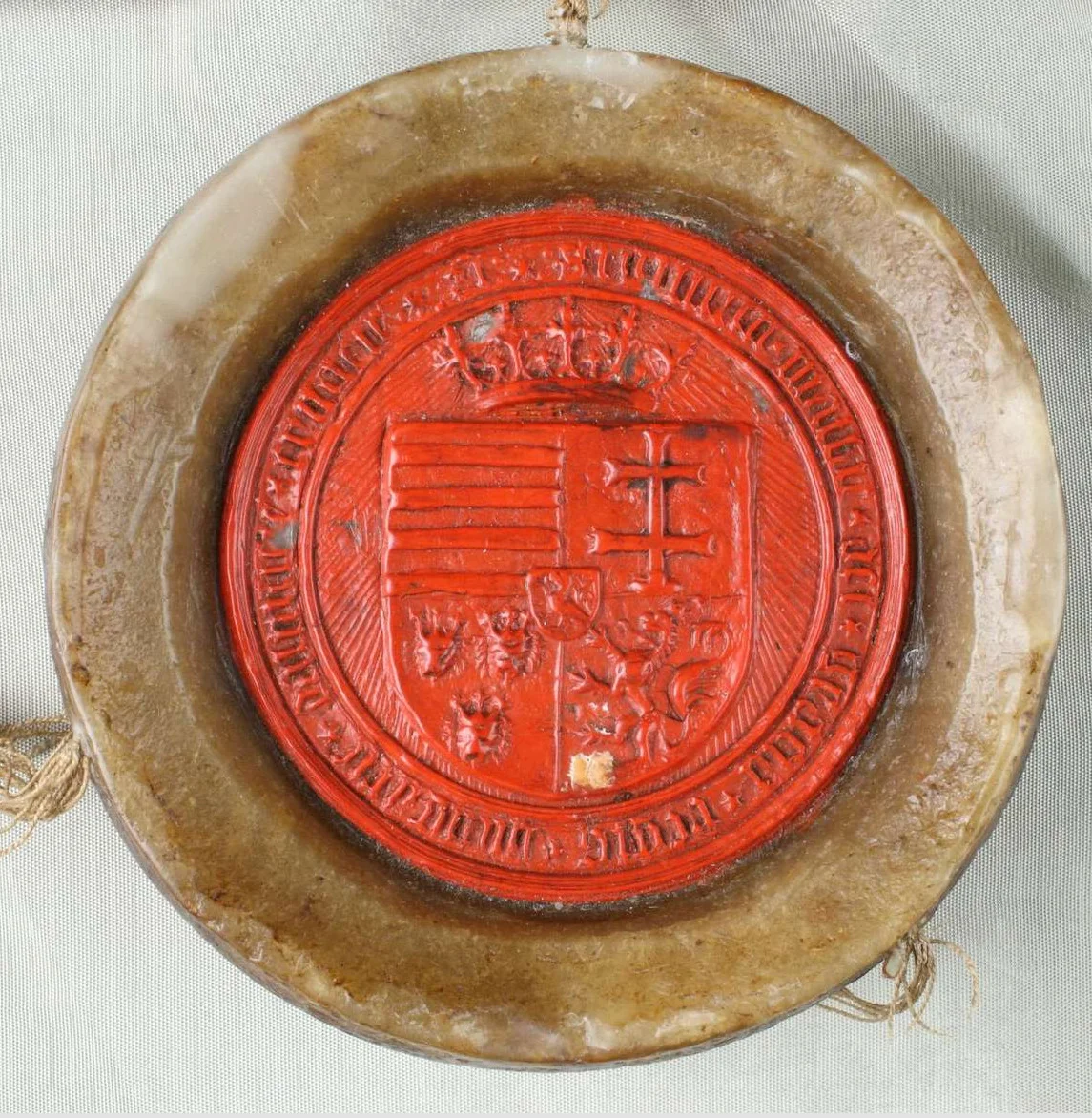
Matthias Corvinus (1458–1490)
King Matthias Corvinus’s pendant privy seal, 1460.
Source: Hungarian National Archives, Budapest — Hungaricana.
DL–DF 39298; former shelfmark: Q 2 / 2 2 459.
2. Mirko Mirković of Scrisia and the Confirmation of Earlier Rights
In 1481, Mirko Mirković of Scrisia appeared before the king. The charter describes him as “nobilis Mirko, filius Georgii Mirkowych de Scrisia” — the noble Mirko, son of Juraj Mirković of Scrisia. This wording provides direct documentary evidence about the person who presented the request concerning Bag’s rights to the king.
Mirko acted on his own behalf and on behalf of the other nobles, citizens and inhabitants of the town and territory of Scrisia, or Bag. He presented the earlier charters to the king and requested confirmation of the community’s existing rights. The document neither names his office nor defines his position in Bag more precisely.
3. Matthias Corvinus’s Charter to Bag — 21 December 1481
On 21 December 1481, Matthias Corvinus confirmed the earlier rights of Bag’s inhabitants. The charter is especially valuable because it incorporates older documents from 1387, 1432 and 1451. A single document thus preserves almost a century of Bag’s legal history, linking privileges granted under the Kurjaković family to the new royal authority.
Elemér Mályusz provides a further clue to the charter’s history in Zsigmondkori Oklevéltár I. (1387–1399). In his summary of the Kurjaković charter of 1387, he states that it is known from Matthias’s document of 21 December 1481 and adds the reference „Mirković cs. lt.”, meaning the Mirković family archive.
4. Bag within the Wider Territory of Matthias’s Rule
The charter of 1481 reliably documents the legal relationship between the king and the community of Bag, but does not in itself explain all the reasons for the king’s interest in the town. Its position beneath Velebit and its connections with the Adriatic coast, Senj and the Krbava hinterland are important to understanding the wider area. Their military, transport and political significance must be interpreted separately from what the surviving documents directly establish.
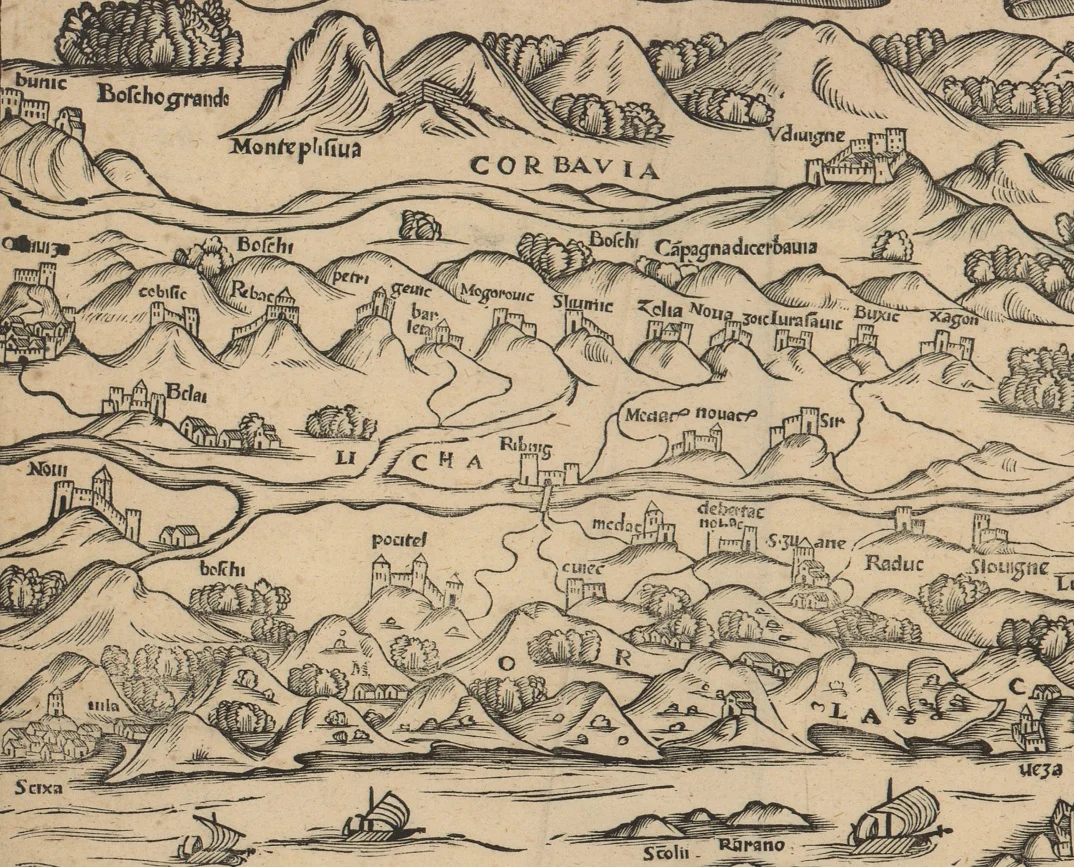
Krbava (Corbavia) and Bag (Scixa) on a map of the Zadar and Šibenik area, c. 1530.
Source: National and University Library in Zagreb, Novak Collection, ZN-Z-XVI-PAG-1530. Matteo Pagano, printer/publisher.
After Matthias’s Death
5. John Corvinus — Bag in a Document of 1490
Matthias Corvinus’s death in 1490 raised new questions about authority over the dynasty’s estates. His son John did not inherit the Hungarian-Croatian crown, but on 11 July of that year Bag appeared again in a document relating to his estates and fortresses.
John Corvinus’s document of 11 July 1490 explicitly lists Baghamong the fortresses. The original is preserved in the Hungarian National Archives under the shelfmark MNL OL DL 72054.
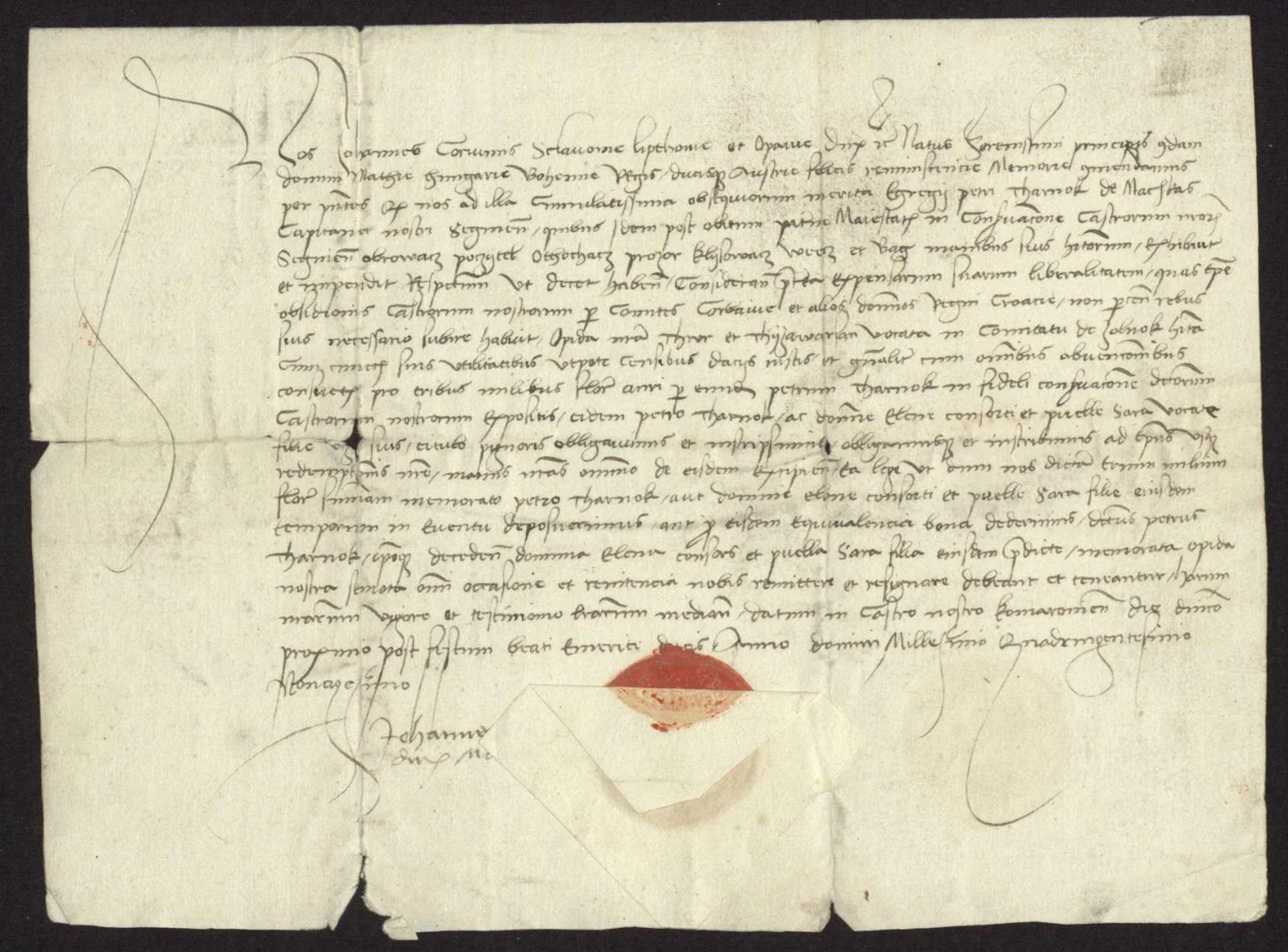
John Corvinus’s Charter — 11 July 1490
MNL OL DL 72054
The original document explicitly listing Bagh among the fortresses.
Source: Magyar Nemzeti Levéltár, Budapest — MNL OL DL 72054.
6. From the Corvinus Dynasty to the Jagiellonians
Following Matthias Corvinus’s death in 1490, Vladislaus II Jagiellon assumed the Hungarian-Croatian crown. John Corvinus retained a substantial portion of his estates and a political role in Croatia. His charter of 11 July 1490 lists Bag among the fortresses associated with Senj.
In 1525, Bag suffered an Ottoman attack. The death of Louis II Jagiellon at the Battle of Mohács in 1526 reopened the question of succession to the Hungarian-Croatian crown.
7. Ferdinand I of Habsburg — 1527
At the Diet of Cetin on 1 January 1527, a section of the Croatian nobility elected Ferdinand I of Habsburg as king. This marked the beginning of the Habsburg period in Croatian history.